
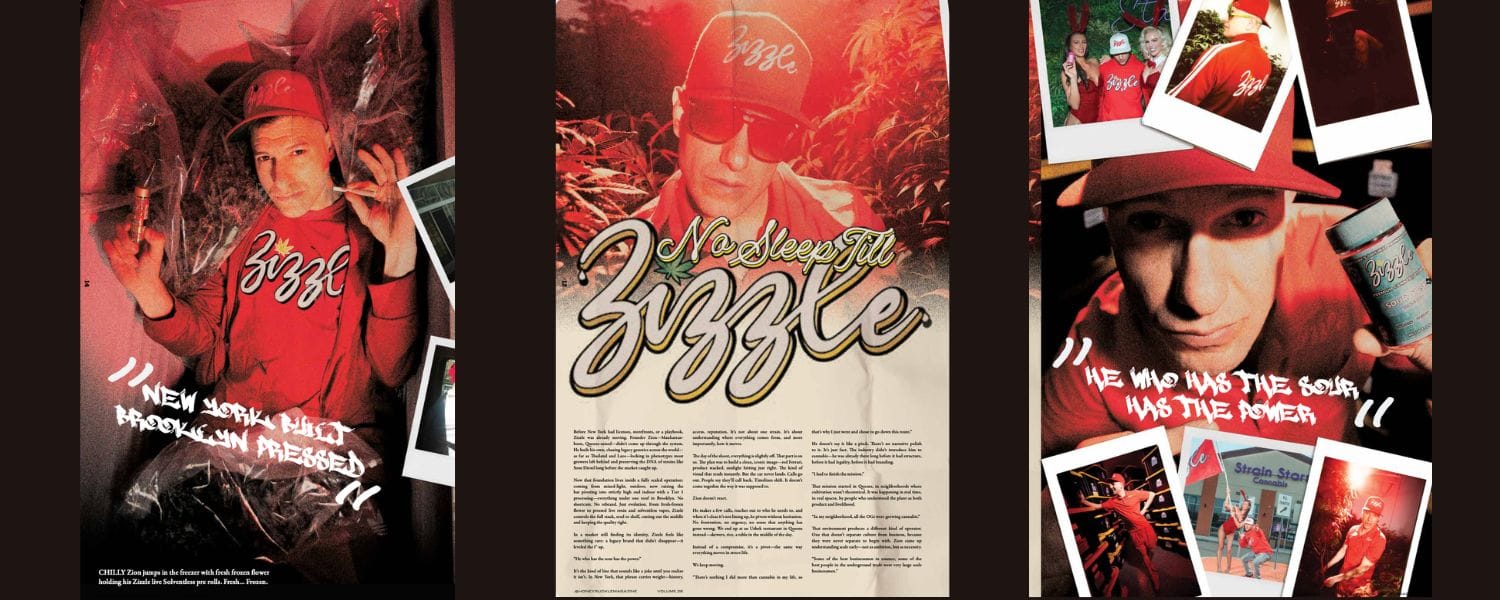
No Sleep Till Zizzle
Before New York had licenses, storefronts, or a playbook, Zizzle was already moving. Founder Zion—Manhattan-born, Queens-raised—didn’t come up through the system. He built his own, chasing legacy genetics across the world—as far as Thailand and Laos—locking in phenotypes most growers left behind and preserving the DNA of strains like Sour Diesel long before the market caught up.
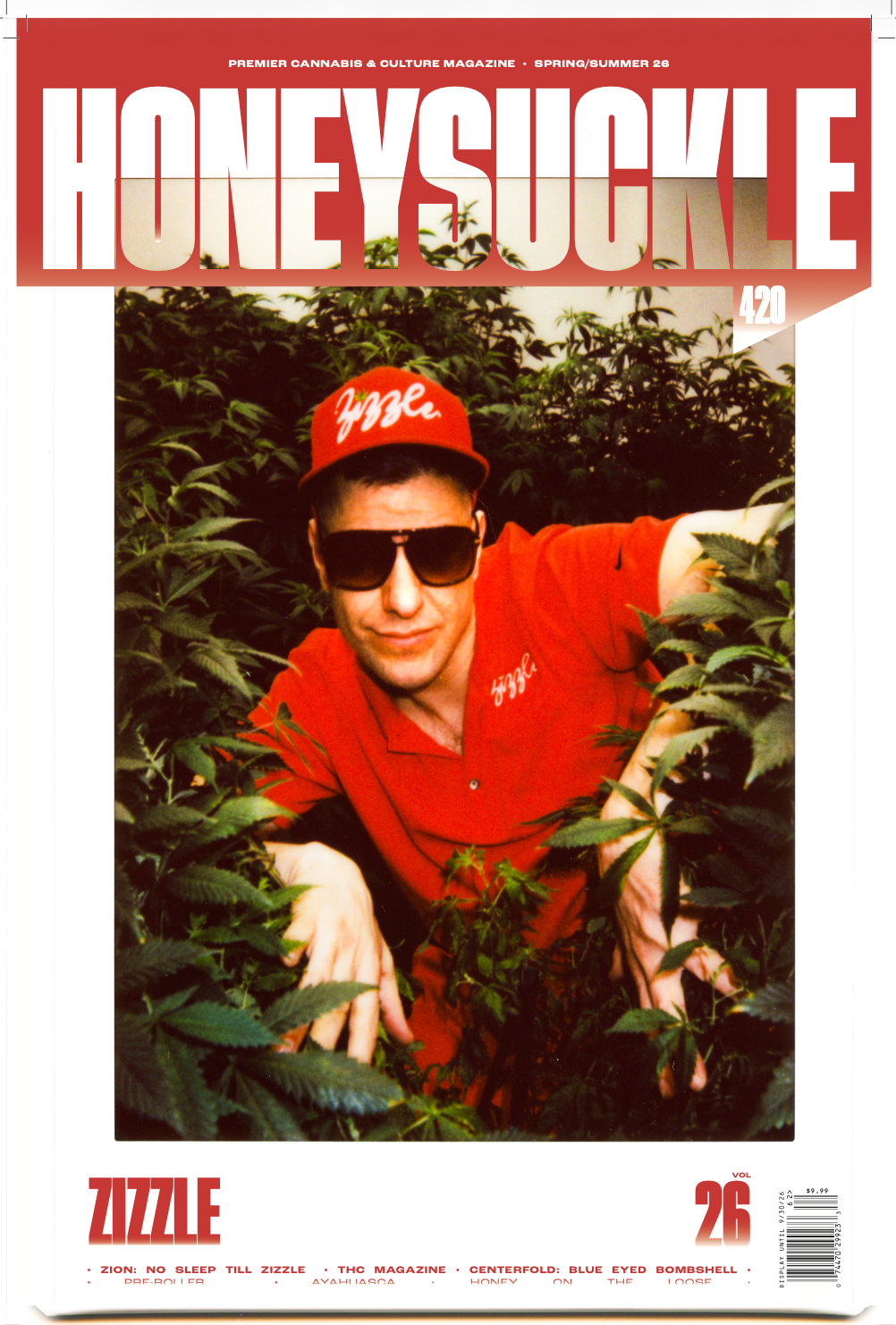
Now that foundation lives inside a fully scaled operation: coming from mixed-light, outdoor, now raising the bar pivoting into strictly high end indoor with a Tier 1 processing—everything under one roof in Brooklyn. No shortcuts. No rebrand. Just evolution. From fresh-frozen flower to pressed live rosin and solventless vapes, Zizzle controls the full stack, seed to shelf, cutting out the middle and keeping the quality tight.
In a market still finding its identity, Zizzle feels like something rare: a legacy brand that didn’t disappear—it leveled the f*** up.
“He who has the sour has the power.”
It’s the kind of line that sounds like a joke until you realize it isn’t. In New York, that phrase carries weight—history, access, reputation. It’s not about one strain. It’s about understanding where everything comes from, and more importantly, how it moves.
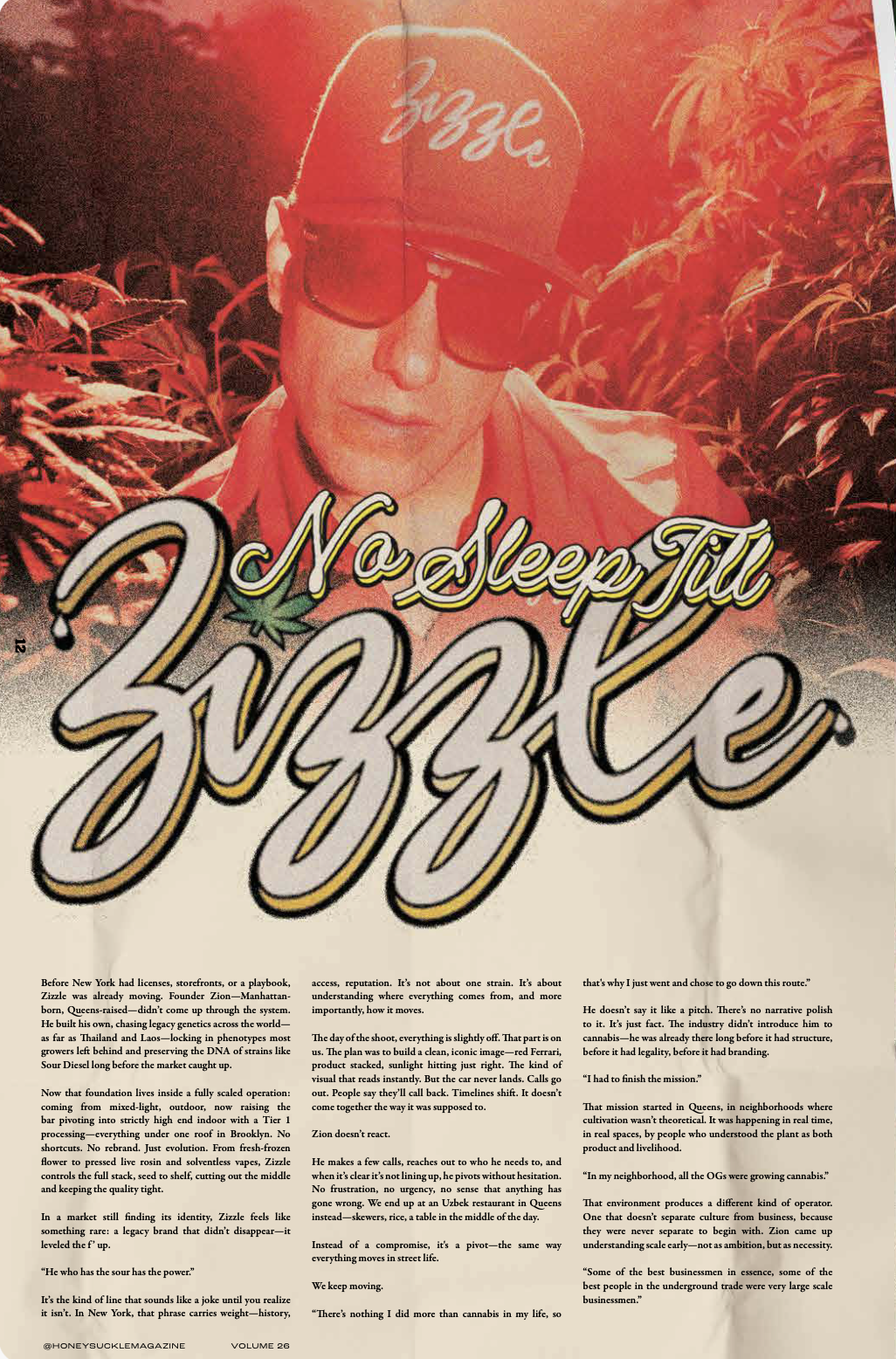
The day of the shoot, everything is slightly off. That part is on us. The plan was to build a clean, iconic image—red Ferrari, product stacked, sunlight hitting just right. The kind of visual that reads instantly. But the car never lands. Calls go out. People say they’ll call back. Timelines shift. It doesn’t come together the way it was supposed to.
Zion doesn’t react.
He makes a few calls, reaches out to who he needs to, and when it’s clear it’s not lining up, he pivots without hesitation. No frustration, no urgency, no sense that anything has gone wrong. We end up at an Uzbek restaurant in Queens instead—skewers, rice, a table in the middle of the day.
Instead of a compromise, it’s a pivot—the same way everything moves in street life.
We keep moving.
“There’s nothing I did more than cannabis in my life, so that’s why I just went and chose to go down this route.”
He doesn’t say it like a pitch. There’s no narrative polish to it. It’s just fact. The industry didn’t introduce him to cannabis—he was already there long before it had structure, before it had legality, before it had branding.
“I had to finish the mission.”
That mission started in Queens, in neighborhoods where cultivation wasn’t theoretical. It was happening in real time, in real spaces, by people who understood the plant as both product and livelihood.
“In my neighborhood, all the OGs were growing cannabis.”
That environment produces a different kind of operator. One that doesn’t separate culture from business, because they were never separate to begin with. Zion came up understanding scale early—not as ambition, but as necessity.
“Some of the best businessmen in essence, some of the best people in the underground trade were very large scale businessmen.”
“We’ve been cultivating since we started.”
That’s the part of the story that doesn’t translate cleanly into the legal market. The word “legacy” gets used loosely now, flattened into branding language, but what it actually represents is infrastructure—networks, sourcing, distribution, relationships built without formal systems.
“We were the first legacy brand to go legal in New York. Pretty cool story.”
He says it almost offhand, but it’s not a small claim. The shift from legacy is all about translation. Taking something that functioned in one reality and forcing it to survive in another.
And the pressure is constant.
“Every dollar goes back into the business, expenses.”
“Taxes. You got families relying on you.”
That last line changes the framing. This isn’t about image. It’s not about lifestyle. There are people tied to this—employees, partners, entire operations that depend on everything working the way it’s supposed to. The stakes aren’t theoretical.
They’re daily. “It’s a 20 hour job a day.”
Back at the table, the conversation shifts the way it always does—with Zion, everything connects back to the source. Genetics come up, and the level of detail is immediate—from Queens, New York to California, Humboldt, Redding, the Inland Empire, Oregon, Laos, Thailand, Amsterdam. Seeds, clones, cuts, carried back, held onto, built over time.
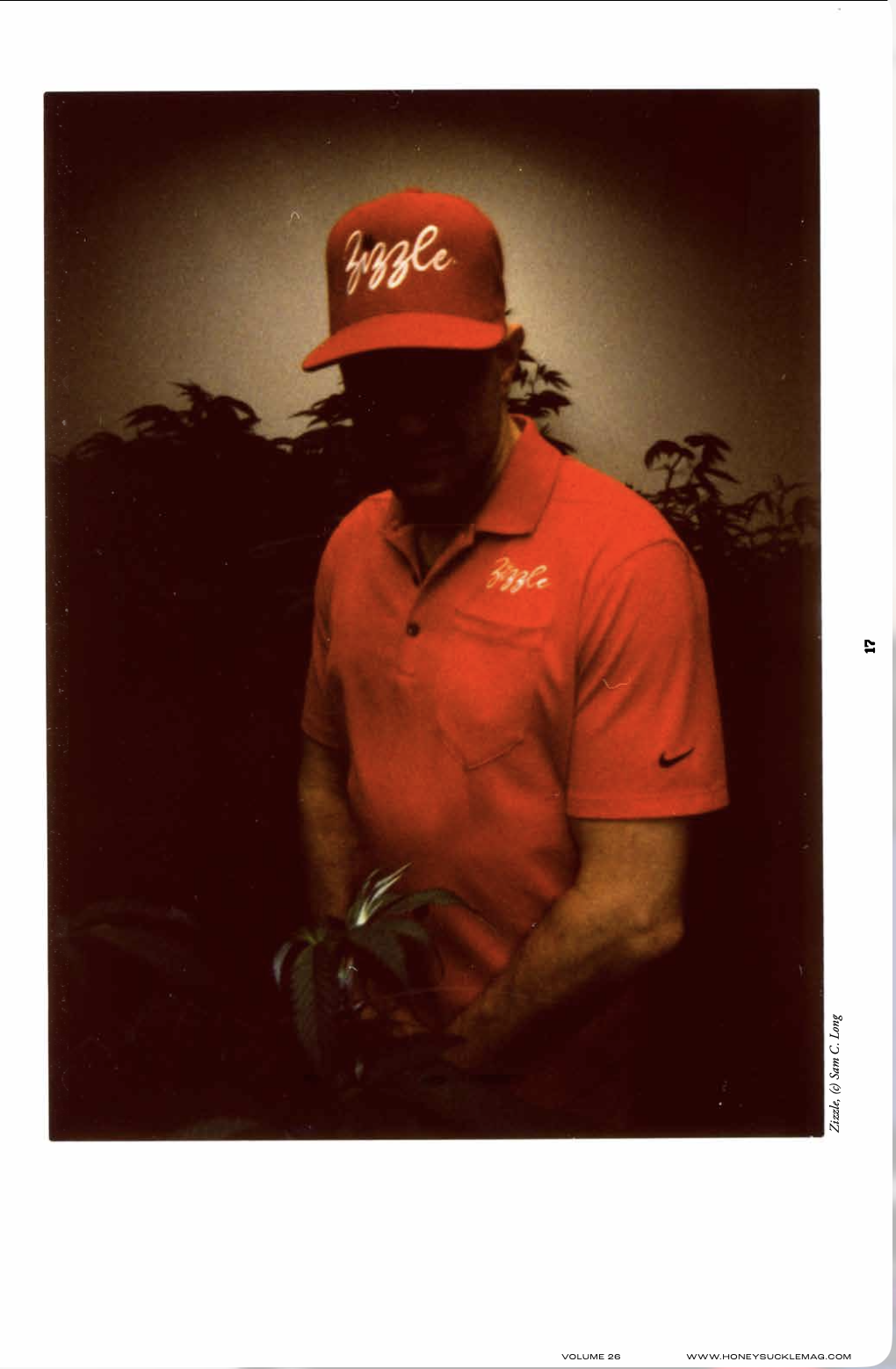
“So the sour was a clone when we first started, but we pop seeds all the time, cross breeding is the key to finding the next banging strain. I have a cross of GDP x LCG (Granddaddy Purple x Lemon Cherry Gelato) I’m experimenting with, tastes like a Jolly Rancher.”
It’s not something he learned in a lab or picked up later. Cultivation is part of the same system he came up in—something you refine over time, something you earn.
We don’t stay at the restaurant long.
We head back to his facility, and the day snaps back into place.
No reset, no overthinking—just execution.
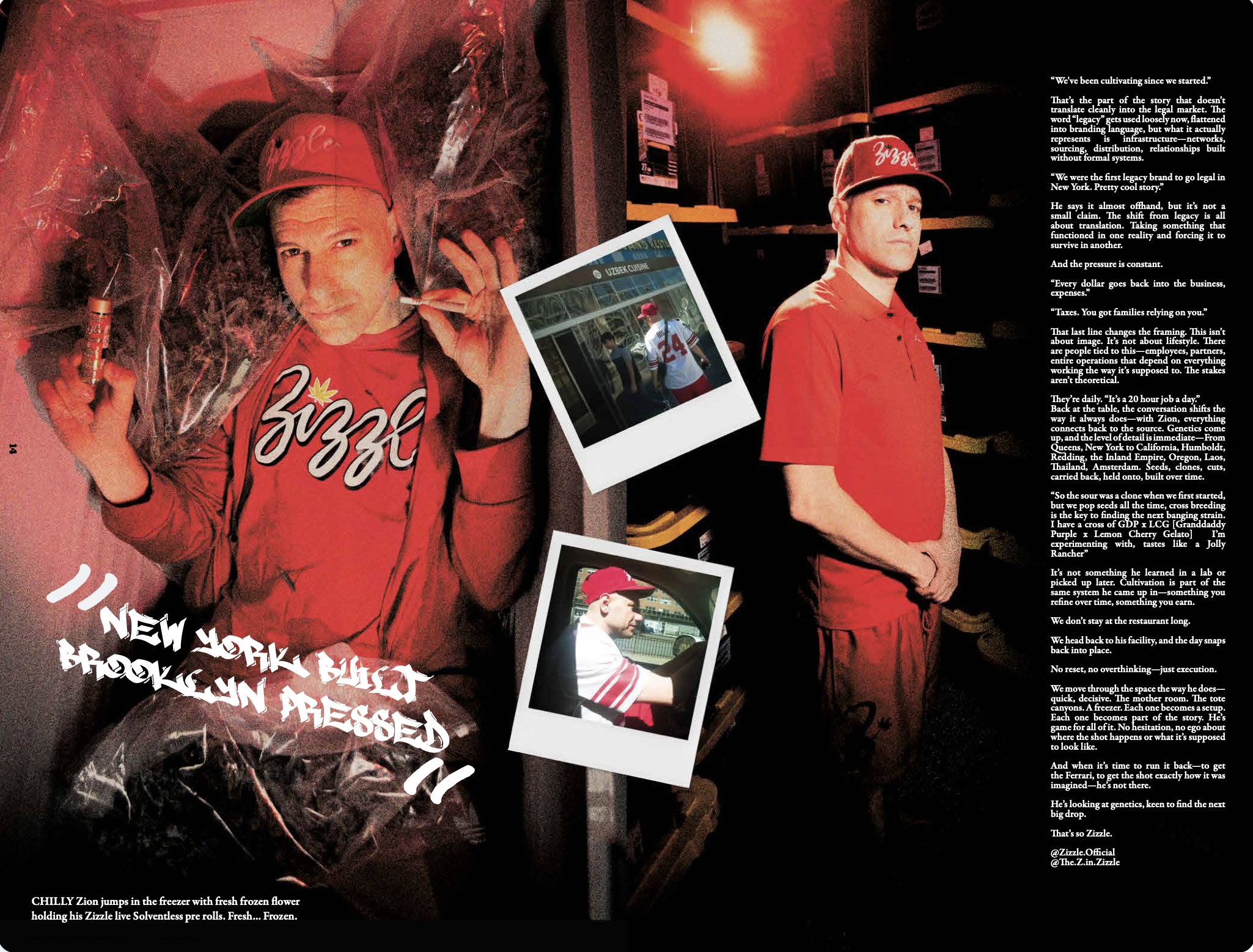
We move through the space the way he does—quick, decisive. The mother room. The tote canyons. A freezer. Each one becomes a setup. Each one becomes part of the story. He’s game for all of it. No hesitation, no ego about where the shot happens or what it’s supposed to look like.
And when it’s time to run it back—to get the Ferrari, to get the shot exactly how it was imagined—he’s not there.
He’s looking at genetics, keen to find the next big drop.
That’s so Zizzle.
@Zizzle.Official
@The.Z.in.Zizzle
Read more in our 420 print edition!
