
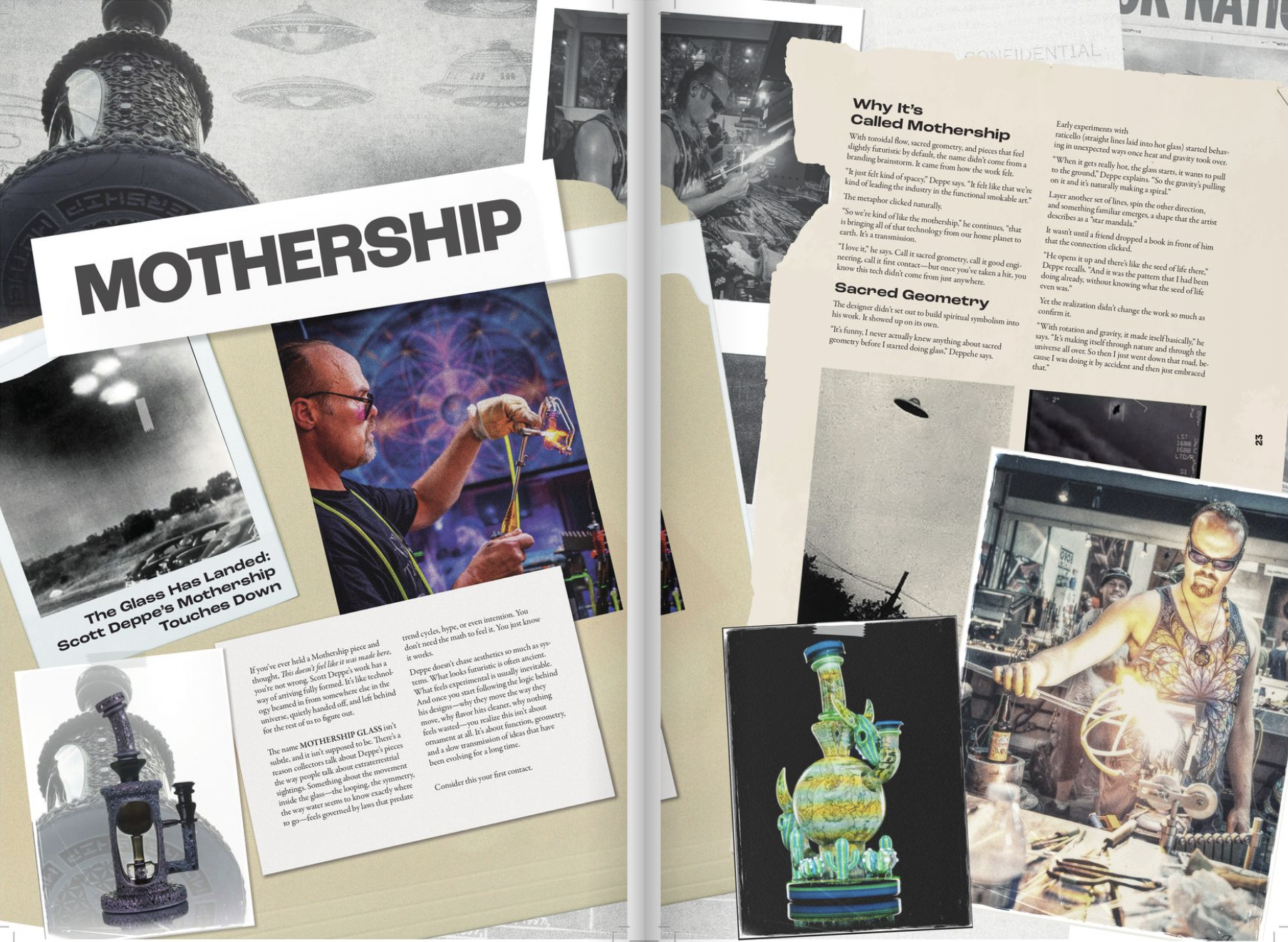
Mothership: Sacred Geometry, Engines, and the Art of First Contact
If you’ve ever held a Mothership piece and thought, this doesn’t feel like it was made here, you’re not wrong. Scott Deppe’s work has a way of arriving fully formed—like its technology beamed in from somewhere else in the universe, quietly handed off, and left behind for the rest of us to figure out.
The name Mothership Glass isn’t subtle—and it isn’t supposed to be. There’s a reason collectors talk about Deppe’s pieces like sightings. Something about the movement inside the glass—the looping, the symmetry, the way water seems to know exactly where to go—feels governed by laws that predate trend cycles, hype, or even intention. You don’t need the math to feel it. You just know it works.
Deppe doesn’t chase aesthetics so much as systems. What looks futuristic is often ancient. What feels experimental is usually inevitable. And once you start following the logic behind his designs, you realize this isn’t about ornamentation at all. It’s about function, geometry, and a slow transmission of ideas that have been evolving for a long time.
Consider this your first contact.
Why It’s Called Mothership
With toroidal flow, sacred geometry, and pieces that feel slightly futuristic by default, the name didn’t come from a branding brainstorm. It came from how the work felt.
“It just felt kind of spacey,” Deppe says. “It felt like that we’re kind of leading the industry in the functional smokable art.”
The metaphor clicked naturally.
“So we’re kind of like the mothership,” he continues, “that is bringing all of that technology from our home planet to earth. It’s a transmission.”
“I love it,” he says. “Call it sacred geometry, call it good engineering, call it first contact—but once you’ve taken a hit, you know this tech didn’t come from just anywhere.”
Sacred Geometry
The designer didn’t set out to build spiritual symbolism into his work. It showed up on its own.
“It’s funny, I never actually knew anything about sacred geometry before I started doing glass,” Deppe says.
Early experiments with reticello—straight lines laid into hot glass—started behaving in unexpected ways once heat and gravity took over.
“When it gets really hot, the glass starts, it wants to pull to the ground,” Deppe explains. “So the gravity’s pulling on it and it’s naturally making a spiral.”
Layer another set of lines, spin the opposite direction, and something familiar begins to emerge—what Deppe describes as a “star mandala.”
It wasn’t until a friend dropped a book in front of him that the connection clicked.
“He opens it up and there’s like the seed of life there,” Deppe recalls. “And it was the pattern that I had been doing already, without knowing what the seed of life even was.”
The realization didn’t change the work so much as confirm it.
“With rotation and gravity, it made itself basically,” he says. “It’s making itself through nature and through the universe all over. So then I just went down that road, because I was doing it by accident and then just embraced that.”
No Overnight Success
From the outside, Mothership can look like a lightning strike—sold-out drops, global collectors, instant recognition. The reality was slower, and a lot more practical.
“That’s how I was enabled to start the company. I couldn’t make enough stuff and my waiting list was years long.”
Demand existed before the company did. Stores kept calling. Orders kept coming.
“So I asked a bunch of the shops that had been asking me for glass,” Deppe explains. “‘I’m starting a company, give me $10,000.’”
All ten said yes.
“And then I had a hundred grand to buy a lathe,” he says, “and be able to pay and buy glass and then take a little time on how to design the pieces and then hire some of my friends and teach them how to make these pieces.”
When the first pieces landed, they flew.
“When the stores all got their stuff, it all sold out instantly,” Deppe says. “And they all wanted more.”
The problem wasn’t hype. It was capacity.
“You can’t just make more glass,” he says. “You have to hire people, train them in the standards.”
And the standards never stopped climbing.
“Every time we just kept on bumping up the bar,” Deppe says. “And not settling.”
Engines, Not Pieces
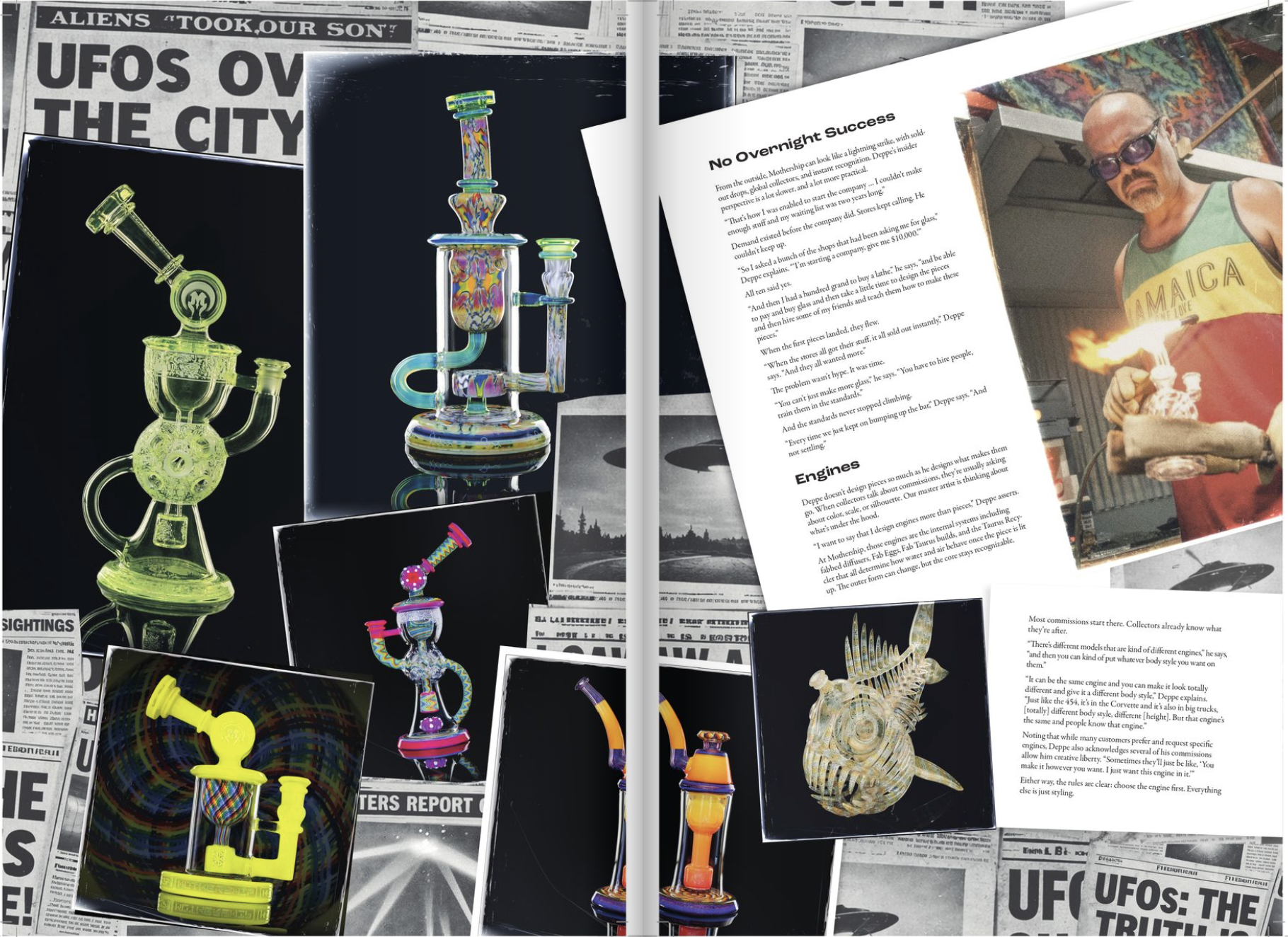
Deppe doesn’t design pieces so much as he designs what makes them go.
At Mothership, those engines are internal systems—fabbed diffusers, Fab Eggs, Taurus builds, and the Taurus Recycler—each one determining how water and air behave once the piece is lit.
“I want to say that I design engines more than pieces,” Deppe asserts.
Collectors might come in asking about color, scale, or silhouette. But the real conversation is happening underneath.
“There’s different models that are kind of different engines,” he says, “and then you can kind of put whatever body style you want on them.”
It’s the same logic as a car platform: one core system, infinite variations.
“It can be the same engine and you can make it look totally different and give it a different body style,” Deppe explains. “Just like the 454, it’s in the Corvette and it’s also in big trucks, [totally] different body style, different [height]. But that engine’s the same and people know that engine.”
For those who know, that’s what matters.
“Choose the engine first,” he says. “Everything else is just styling.”
Ice, Water, and Intention
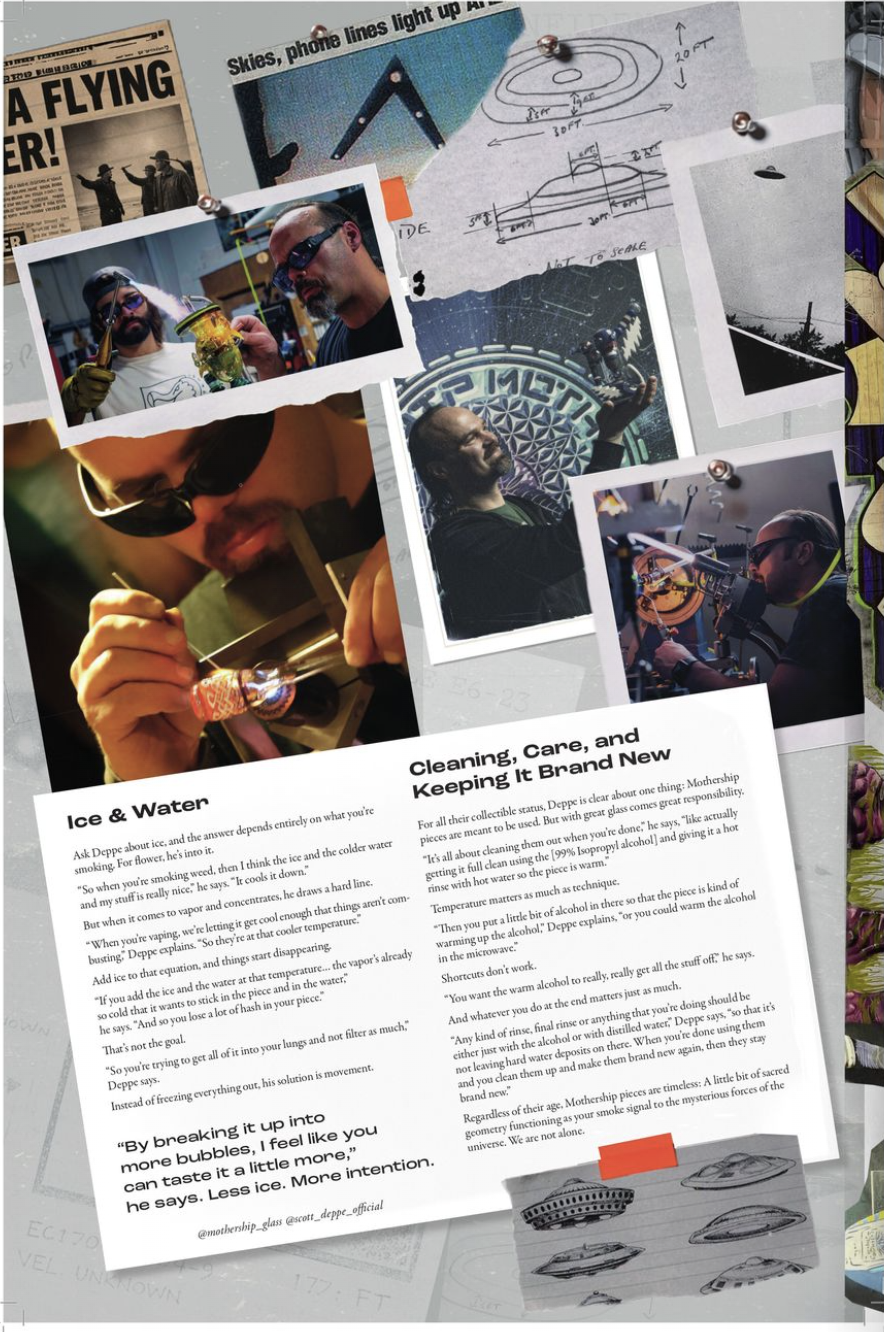
Ask Deppe about ice, and the answer depends entirely on what you’re smoking.
For flower, he’s into it.
“So when you’re smoking weed, then I think the ice and the colder water and my stuff is really nice,” he says. “It cools it down.”
But when it comes to vapor and concentrates, he draws a hard line.
“When you’re vaping, we’re trying to get it cool enough that things aren’t combusting,” Deppe explains. “So they’re at that cooler temperature.”
Add ice to that equation, and things start disappearing.
“If you add the ice and the water at that temperature… the vapor’s already so cold that it wants to stick in the piece and in the water,” he says. “And so you lose a lot of hash in your piece.”
That’s not the goal.
“So you’re trying to get all of it into your lungs and not filter as much,” Deppe says.
Instead of freezing everything out, his solution is movement.
“By breaking it up into more bubbles, I feel like you can taste it a little more,” he says. “Less ice. More intention.”
Cleaning, Care, and Keeping It Brand New
For all their collectible status, Mothership pieces are meant to be used. But with that comes responsibility.
“It’s all about cleaning them out when you’re done,” Deppe says, recommending a full clean using 99% isopropyl alcohol followed by a hot water rinse while the piece is warm.
Temperature matters as much as technique.
“You can put a little bit of alcohol in there so that the piece is kind of warming up the alcohol,” he explains, “or you could warm the alcohol in the microwave.”
Shortcuts don’t work.
“You want the warm alcohol to really, really get all the stuff off,” he says.
And the final step matters just as much.
“Any kind of rinse, final rinse or anything that you’re doing should be either just with the alcohol or with distilled water,” Deppe says, so there’s no residue left behind.
Do it right, and the piece stays what it was meant to be.
“Brand new.”
Regardless of their age, Mothership pieces feel timeless—less like objects and more like transmissions. A little bit of sacred geometry functioning as your smoke signal to the universe.
We are not alone.
Read more about Scott Deppe and Mothership in our February print edition!
Learn more at mothershipglass.com and Instagram
SEO URL
/mothership-glass-scott-deppe-sacred-geometry-functional-art
