
By Tuulikki Robertson, Executive Director of The Black Institute’s Social Equity and Racial Justice Project
When New York legalized adult-use cannabis in 2021, the law came with a promise: Communities most devastated by the War on Drugs would be among the first to benefit from the legal industry.
Five years later, that promise remains only partially fulfilled.
Licensing delays, litigation, limited access to capital and a market increasingly shaped by companies with the deepest pockets have left many Black and Brown entrepreneurs, advocates and workers on the outside looking in.
The Black Institute is not waiting for the state to catch up.
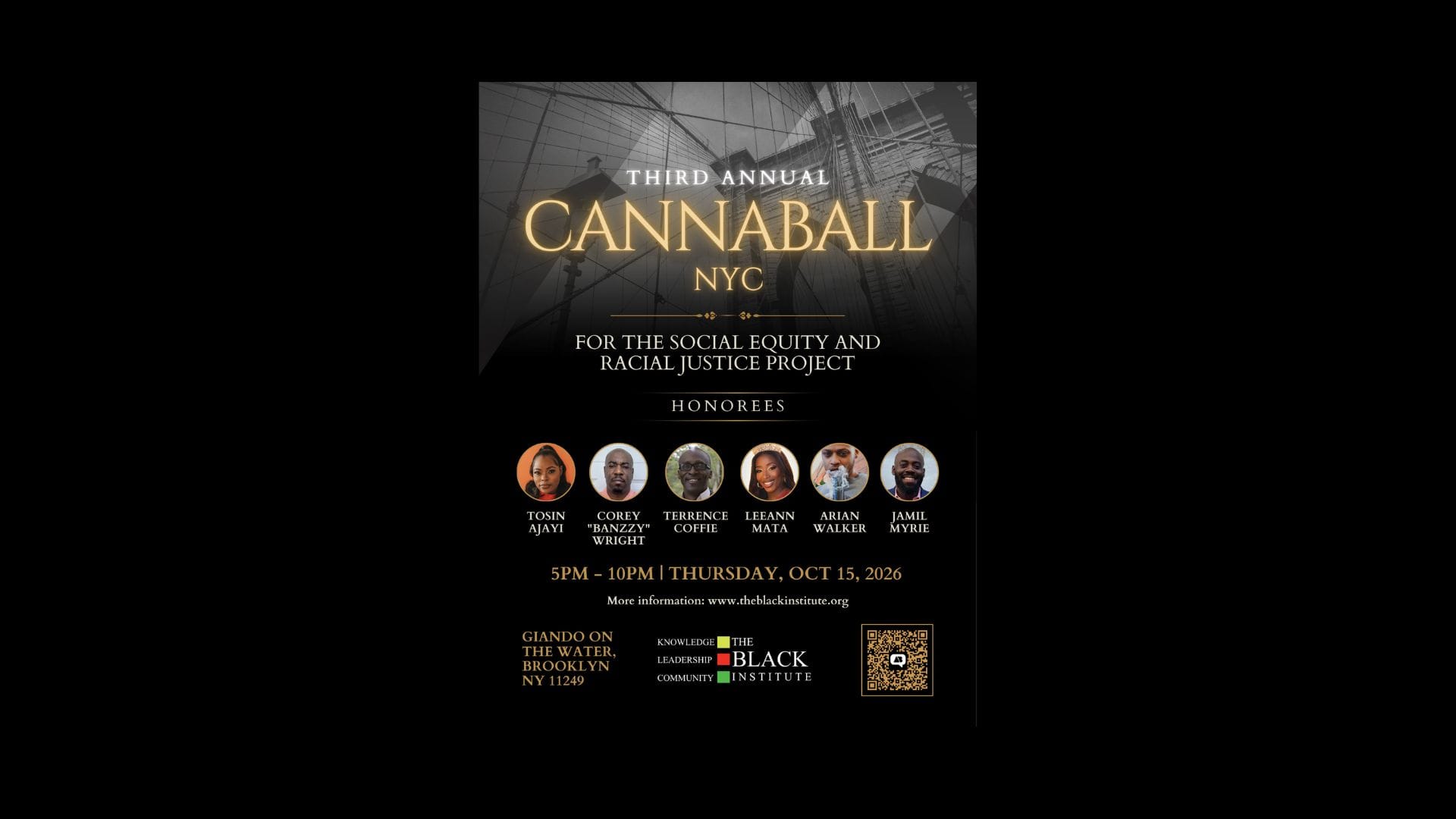
Through its Social Equity and Racial Justice Project, the organization will return with the third annual Canna Ball NYC, an event grounded in three central commitments: education, oversight and the development of a trusted community network.
Recognizing the Communities That Built the Culture
The legal cannabis industry did not appear overnight. It was built by people who sustained the culture through decades when possessing the same plant now sold in licensed storefronts could lead to arrest, incarceration, job loss and family separation.
Black and Brown New Yorkers experienced the consequences of cannabis enforcement at disproportionate rates, despite data showing similar usage rates across racial groups.
That history is not separate from the legal market. It is the reason social equity became a central part of legalization in the first place.
However, equity goals do not enforce themselves.
The Black Institute works to monitor New York’s rollout, hold agencies and industry participants accountable and ensure that the communities legalization was intended to support are not pushed aside by familiar barriers.
Access to funding, commercial real estate, professional networks and technical assistance have historically limited opportunities for Black entrepreneurs across industries. Without meaningful oversight and intervention, those same barriers risk becoming permanent features of New York’s cannabis market.
Education, Accountability and Connection
Creating a sustainable and equitable industry also requires education.
Entrepreneurs need access to reliable information about licensing, compliance, financing and business operations. Advocates need opportunities to connect, share resources and build collective power.
For The Black Institute, creating that trusted network is not simply a benefit of Canna Ball NYC. It is the event’s central purpose.
Canna Ball provides a space to celebrate the people shaping the industry while creating stronger relationships between operators, policymakers, advocates, workers and community members.
Honoring New York’s Cannabis Leaders
This year’s Canna Ball NYC will recognize individuals representing several levels of the ongoing fight for equity.
The Assembly Member Crystal Peoples-Stokes New York State Pioneer Honor will recognize Tosin Ajayi, Senior Policy and Research Analyst at Cannabis NYC. Ajayi’s policy work continues to influence how social and economic equity is defined and implemented throughout the city’s cannabis industry.
The Legacy Honor will be presented to Corey Banzy, a Harlem-based Legacy-to-Legal Tier 3 brand operator whose journey reflects the transition from the legacy market into New York’s regulated industry.
The Trailblazer Honor will recognize Leanne Mata, founder of Matawana and one of New York’s pioneering Black women cannabis business owners.
The Black Excellence in Cannabis Honor will recognize Arian Walker, a respected budtender and advocate working on the front lines of the industry.
The event will also honor Terrence Coffie and Jamil Myrie of the Cannabis Justice and Equity Initiative. The nationally recognized advocates have worked to advance restorative justice, policy reform and equitable participation across the cannabis sector.
Together, the honorees represent the entrepreneurs, policymakers, advocates and workers fighting to ensure that the legal industry remains connected to the communities and culture that made it possible.
Introducing the Black Business Happy Hour
This year’s Canna Ball NYC will also introduce a new Black Business Happy Hour, a showcase reserved exclusively for Black-owned cannabis brands and businesses.
Taking place ahead of the main event, the Happy Hour will provide participating companies with an opportunity to present their products, services and stories to an audience committed to supporting Black ownership and entrepreneurship.
Any Black-owned cannabis business is welcome to participate.
The addition reflects a core belief behind the event: Representation inside a room is not the same as meaningful opportunity within a market.
Canna Ball NYC intends to create space for both.
Celebrating Equity Without Waiting for Permission
If New York State does not fully recognize the people who sustained cannabis culture through prohibition and are now working to build legitimate businesses, The Black Institute will.
Canna Ball NYC is a declaration that the contributions of Black and Brown entrepreneurs and community leaders will be documented, celebrated and supported.
Their stories will not be treated as an afterthought in an industry built on the sacrifices, risks and cultural labor of communities disproportionately harmed by cannabis criminalization.
Early-bird tickets are available through the end of August, and sponsorship opportunities are open for organizations seeking to support the event and its equity-focused mission.
For tickets, sponsorship opportunities and additional information, visit The Black Institute’s website or contact info@theblackinstitute.org.
About The Black Institute
The Black Institute is an action tank focused on developing and advancing policy solutions that address racial disparities in education, healthcare, economic development and other areas.
Through research, leadership development, community organizing and public education, the organization works to move policy beyond academic discussion and transform it into tangible action, accessible information and lasting community power.
