
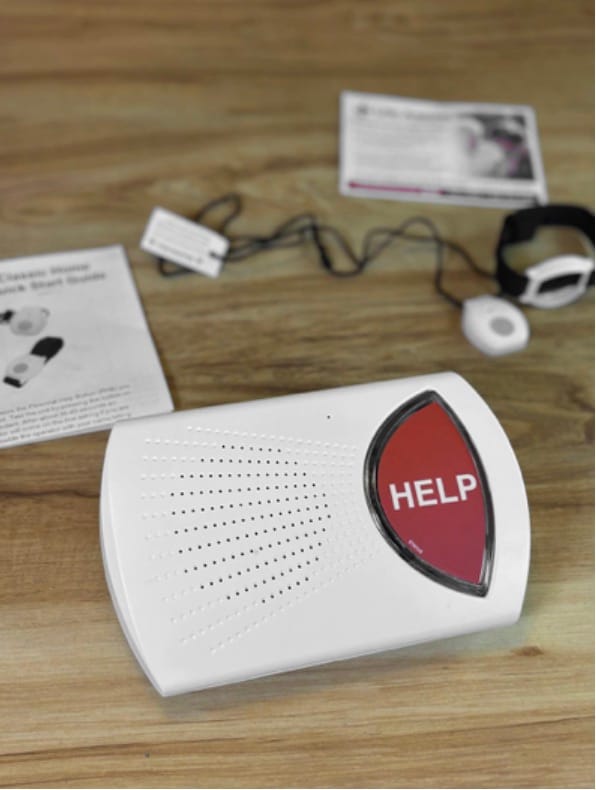
Almost every piece of advice about getting older contains the same hidden character. An adult child, 20 minutes away, with a spare key and a flexible job. Hospital forms assume them. Discharge planners assume them.
Alt text: A white home base unit with a perforated speaker grille and a large red HELP button on a wooden table, with a quick start guide, a pendant on a cord and a wristband laid out behind it
For a lot of people that person does not exist. Life Assure medical alert systems and services like them sell into that gap. They offer a monitored line rather than a family one. Life Assure is a Canadian company, and its monitoring service is available to customers in Canada only. Readers in the United States cannot sign up to it.
Most alarm companies build their call trees to ring a relative first. That default is the thing worth examining.
Who Actually Gets Called When Something Happens?
Whoever is written down. That is the whole of it, and it is why the paperwork matters more than the sentiment.
A monitored service keeps a household record. When a button is pressed, the Medical Alert Specialists read that screen. They work down the contacts in the order they were entered. If the list is a sister in another state and a landline disconnected in 2019, that is what happens at 3am.
The default list often does not fit, a point advocacy work with queer elders has been making for years. Estrangement, distance and outliving a chosen circle all produce the same practical result.
Why the Assumption Fails More Often Than It Should
Three patterns account for most of it, and none are unusual.
- No adult children. A large share of LGBTQ+ elders do not have them, and plenty of straight people do not either.
- Geographic scatter. Adult children exist but live 3 states away, which is useful for phone calls and useless at 2am.
- Estrangement. The person on the form is legally next of kin and has not spoken to the patient in a decade.
The third is the most awkward and the least discussed. Legal next of kin is not the same as the person you would want deciding. Hospitals default to the former unless told otherwise in writing.
That gap has a long history behind it. It runs back through the fights that Marsha P. Johnson and the movement she helped build took on. Recognition of chosen family has improved. The forms have not entirely caught up.
What Does Chosen Family Change About Planning?
It changes what has to be written down, and how early.
Image courtesy of Life Assure
Alt text: A small black rectangular alarm unit with a round button and speaker grille, worn on a black cord lanyard over a cream sweatshirt
A blood relative is presumed. A friend of 30 years is not. That asymmetry is the whole problem. Documentation converts one into the other, and it has to exist beforehand.
Health care proxies, powers of attorney and visitation forms all do different jobs. Which document does what varies by state, and the legal resources gathered for LGBTQ+ families are a reasonable starting point. None of them work retroactively.
Where Does a Monitored Device Fit?
In the first link of the chain, before any of the paperwork matters.
A pendant or wristband is not a care plan. What it does is guarantee that someone picks up, which is the single assumption that fails when there is no one downstairs. A staffed center answering at 3am does not need to be related to anyone.
That is worth separating from the medical side. Regular clinical contact is a different thing entirely, and a case for senior primary care as its own relationship sits alongside rather than inside this.
Two practical features matter more for people living alone. Fall detection covers the case where nobody presses anything, and a mobile unit covers the fact that a home-only base station is useless on a sidewalk.
What to Put In the File Before You Need It
- Three contacts minimum, in the order you actually want them called.
- Their relationship as you define it, not as a form's dropdown defines it.
- A key holder, with the arrangement written down and reviewed yearly.
- Medical basics, including conditions and anything a responder should know on arrival.
- Your proxy documents, and confirmation that the people named have copies.
Review it every year. Contact lists rot faster than anyone expects, and a list assembled in 2021 is probably wrong in at least one place.
Tell the people on it that they are on it. This sounds obvious and is skipped constantly. A friend who learns at 3am that they are your second call handles it worse than one who agreed to it over coffee two years earlier.
Building a Plan That Does Not Assume a Daughter
The template was written for a household shape that plenty of people do not have. That is a design failure, not a personal one.
Fixing it is mostly clerical. Write down who you want called, sign the documents that make it stick, and put one arrangement in place that does not depend on a relative answering the phone.
FAQ
Who Is Called First If I Live Alone?
Whoever appears first on the record you gave the provider. That order is editable, and it should reflect who can actually reach you rather than who is related to you.
Can a Friend Be My Emergency Contact and Proxy?
Yes, but it needs documenting. A health care proxy names the person you choose, and without it hospitals fall back on legal next of kin.
Does a Monitored Alarm Replace Having People Nearby?
No. It guarantees an answer and a dispatch, which is narrower than the support a neighbor or friend provides, and the two are not interchangeable.
How Often Should the Contact List Be Reviewed?
Once a year is a reasonable minimum. Numbers change, people move, and a stale list fails at exactly the moment it is needed.
