
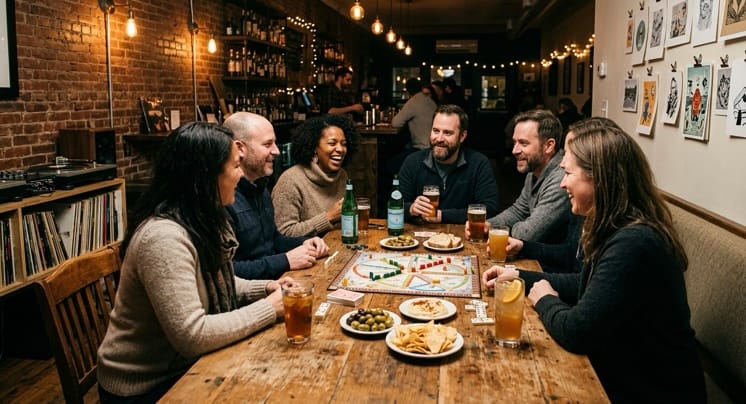
It’s a Thursday evening in an independent bar: a local illustrator’s prints are clipped along one wall, somebody has put together a playlist that moves from soul to post-punk without making a fuss about it, and a table in the corner is sorting out the rules for a board game. There’s food being passed about, plenty of chat, and nobody seems in a rush to turn the night into a competition.
That’s the appeal of contemporary game-night culture. It can sit somewhere between a pub social, a small arts event and a relaxed gathering at a mate’s flat. For adults who enjoy a little structure to an evening, games offer a reason to linger and talk without requiring anyone to be the loudest person in the room.
Some nights may include a casino-style table game, while others stick to cards, quizzes, dominoes or tabletop games. The important bit isn’t the format. It’s the atmosphere: good company, clear boundaries and a shared understanding that spending money or taking risks is never the price of belonging.
The social ritual matters more than the score
The strongest game nights tend to have a rhythm. People arrive, find a drink or a soft option, have a look at the food, and settle into conversation before any rules are explained. The game is there, but it isn’t doing all the work.
Independent venues have become particularly good at creating this feeling. A café might host a design-market evening with casual card tables. A record shop may turn a late opening into a quiz night. A community arts space might bring in a local DJ and ask a ceramicist to run a small pop-up stall. These details make an event feel made by people rather than processed for customers.
There’s also room for adult conversations about responsible consumption. Some venues operate in places where cannabis is legal, or where attendees may raise questions about it. A considerate host doesn’t make assumptions. They make expectations clear, follow local rules, respect people who don’t want to be around it, and make sure nobody feels pressured to take part in anything.
That same principle applies to alcohol and gambling. A welcoming night is one where opting out is completely ordinary.
A few small choices can set the tone:
- Put non-alcoholic drinks on the menu as a normal part of the offer.
- Make food, seating and quieter corners available where possible.
- Explain the rules without talking down to newcomers.
- Ensure people can join a conversation without joining a game.
- Keep any money-based activity optional, limited and separate from social status.
- Make it easy for someone to head home without a fuss.
I find the best gatherings leave people with a story about a strange answer in the quiz, an excellent song somebody played, or a new artist whose work they spotted on the wall. Nobody needs to prove they were “serious” about the night.
Considerate nights out are designed, not accidental
There’s a quiet skill to hosting an event where different people can relax. It starts long before the first guest arrives.
Think about access. Is the venue reachable by public transport? Is there step-free entry? Is the music at a level that still allows conversation? Are there clear prices, including a free or low-cost way to take part? These questions aren’t decorative. They shape who gets to feel comfortable in the room.
Social equity matters here, too. A night out can become exclusionary when every part of it requires spending. That doesn’t mean venues and artists shouldn’t be paid, they absolutely should. It means organisers can be upfront about costs and offer different ways to engage. Perhaps there’s a ticket that includes food, a pay-what-you-can community table, or simply a welcoming space for people who want to listen and chat without signing up for every activity.
Shared playlists are a surprisingly effective tool. Ask guests for a song suggestion beforehand, then include a selection during the evening. It gives people a small stake in the mood and often breaks the ice faster than a formal introduction. Local art works in much the same way. It gives the room something to notice together.
Consent belongs in the picture as well. That might mean asking before taking photographs, checking whether somebody wants to join a team, or accepting a polite “no thanks” without a follow-up sales pitch. Good hosts treat boundaries as part of the hospitality.
A simple host’s brief
For a non-gambling social gathering, it can help to set out the basics in advance:
- What’s happening: name the games or activities, but don’t imply everyone must participate.
- What it costs: be plain about entry, food and any optional paid elements.
- What the room is like: mention seating, noise, access and whether people can come alone.
- What behaviour is expected: respect others, get consent before photos, and don’t pressure anyone to drink, spend or play.
- When it ends: a clear finishing time is kind to guests and staff alike.
It sounds straightforward because it is. Yet these little signals can make the difference between a tense evening and one that feels genuinely open.
What people who make these nights say
A host at a small London community venue put it neatly during a conversation about social events: “The aim is to give people something to gather around, not something to measure themselves against.”
That distinction is useful. A game can be a prompt for laughter and connection, but it can also become awkward when the focus shifts to who has spent most, knows the most, or is prepared to take the biggest risk. A thoughtful host can steer away from that simply by offering choices.
A harm-reduction-minded organiser might add that information should be available without being dramatic. Clear rules, water, food, breaks and an easy route out of an activity all help people make their own decisions. Nobody should have to explain why they’re sitting a round out.
Creative workers often understand this instinctively. An illustrator selling prints at an event doesn’t need every attendee to buy something for the evening to feel worthwhile. Musicians, DJs and artists benefit from attentive audiences, respectful conversation and fair payment arrangements. Community isn’t a receipt total.
Roulette, explained without the mystique
For adults who encounter casino games at a venue or online, a little plain-language understanding is useful.
Roulette is a chance-based table game. A dealer, often called a croupier, spins a wheel in one direction and a ball in the other. The ball eventually lands in a numbered pocket. Players may select individual numbers or groups such as red or black, odd or even, or ranges of numbers. The basic mechanics are described in Monopoly Casino's roulette.
The key point is that roulette is not a skill contest. You can understand the layout, the types of bets and the stated payouts, but that knowledge doesn’t give you control over where the ball lands. Each spin is uncertain, and the game is designed with a house edge.
It’s also different from sports betting. Sports betting involves predictions about sporting events, such as a match result or a player statistic. Roulette has no sporting event behind it. They may appear under the broad umbrella of gambling, but they are distinct activities and shouldn’t be muddled together.
So what does a small stake mean? In practical terms, it means setting aside a limited amount that you have already decided is part of an evening’s entertainment, knowing it may be lost. It does not mean a route to income, a test of personal judgement, or a reason to continue after an unwanted result.
That framing is worth keeping close. The social side of a game night should still be enjoyable if no money changes hands at all.
## Before You Play
This checklist is for adults only:
- Confirm that you are **18 or over** and that gambling is legal where you are.
- Decide on a fixed entertainment budget before you begin, and do not exceed it.
- Set a time limit, then stop when that time arrives.
- Do not increase your spending in response to a loss.
- Keep gambling separate from bills, savings and everyday essentials.
- If it stops feeling recreational, take a break and contact a support service such as [GamCare](https://www.gamcare.org.uk/) or the [National Gambling Helpline](https://www.gamcare.org.uk/get-support/talk-to-us-now/).
In Great Britain, the Gambling Commission’s guidance provides further information on safer gambling and ways to seek help.
Keep the night bigger than any one activity
A game night doesn’t need a dramatic centrepiece to work. Sometimes the most memorable part is the shared plate of chips, a surprisingly good conversation with somebody new, or a song that gets added to your own playlist the next day.
That’s why lower-pressure events matter. They give adults room to choose their level of involvement, respect each other’s limits and enjoy local culture without turning every social occasion into a transaction.
