
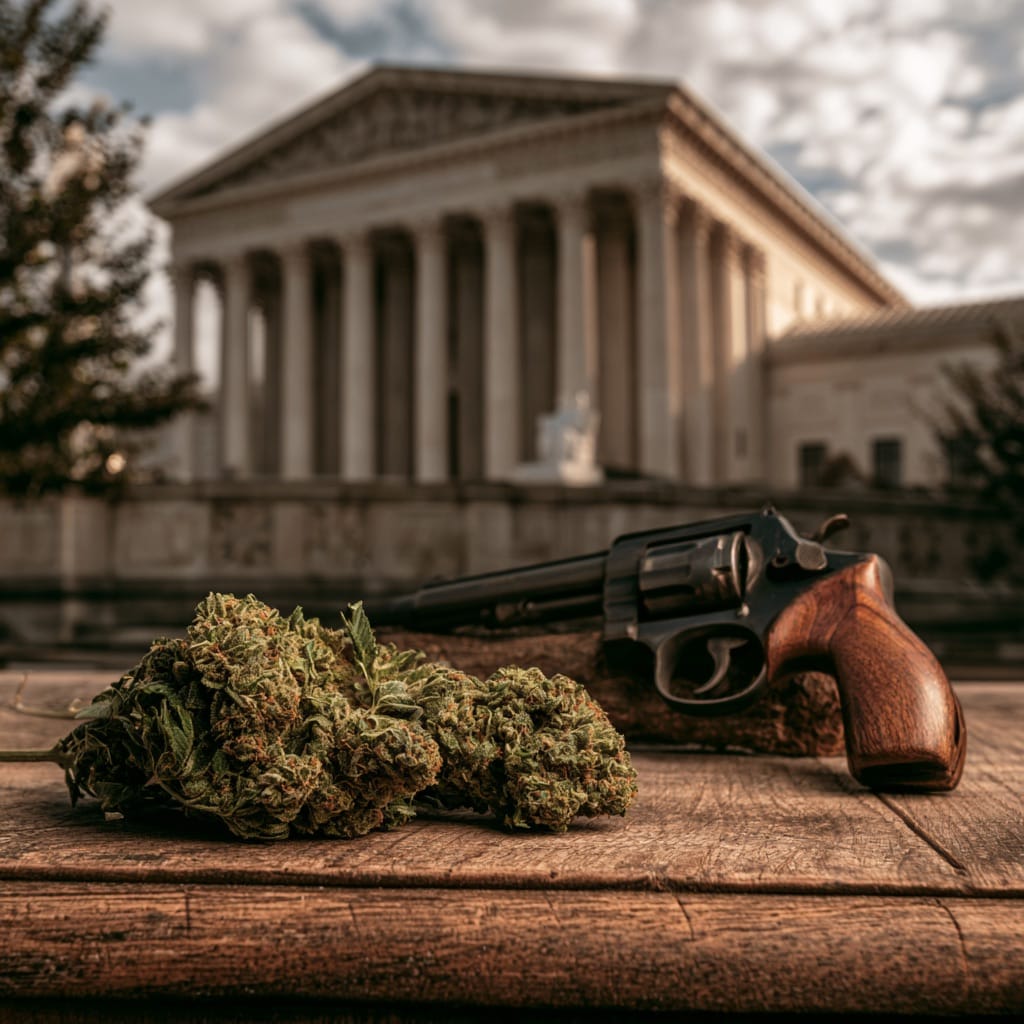
The U.S. Supreme Court delivered a major victory for cannabis consumers this week, unanimously ruling in United States v. Hemani that the federal government cannot prosecute someone under federal firearms laws solely because they regularly use cannabis.
The decision marks another significant development in a year already defined by shifting federal cannabis policy. Following the April 2026 rescheduling of medical cannabis to Schedule III, the ruling adds to a growing body of legal precedent that continues to reshape the relationship between federal law, cannabis consumers, and constitutional protections.
While the Court emphasized that its ruling is narrow—preserving restrictions on individuals who are intoxicated, addicted, or otherwise shown to pose a danger to themselves or others—the decision challenges a longstanding federal assumption that cannabis use alone is sufficient grounds for denying certain constitutional rights.
For many advocates and industry leaders, the ruling represents more than a legal technicality. It reflects a broader shift in how the federal government views cannabis consumers.
A Question of Personal Freedom
For Sarah Strickler, Co-Founder and Chief Community Officer of Grown Rogue, the ruling resonates deeply with the culture of Southern Oregon, where cannabis, agriculture, and hunting traditions often coexist.
Strickler described growing up in the Rogue Valley, a region where personal liberty and respect for the land are deeply held values. She noted that many residents are both firearm owners and cannabis consumers, a reality that has long conflicted with federal law.
"We started growing cannabis in Southern Oregon in 2006," Strickler said. "For years, I carried real shame about it. Not because I thought what we were doing was wrong, but because the laws and the stigma made people feel like they had to hide."
According to Strickler, the Supreme Court's decision acknowledges what many cannabis consumers have argued for years: that responsible cannabis use does not inherently make someone a threat to their community.
"Using cannabis doesn't make you a danger to your community and it doesn't disqualify you from the same rights that every other American has," she said.
While acknowledging that broader reform remains necessary, Strickler called the ruling an important step toward treating cannabis consumers as responsible adults rather than second-class citizens.
Financial Markets See Signs of Normalization
Beyond its implications for consumers, the decision is also being viewed through an economic lens.
Anthony Coniglio, President and CEO of NewLake Capital Partners, believes the ruling could have meaningful implications for market growth and investor confidence.
"Today's unanimous Supreme Court ruling is a landmark moment for the cannabis industry's credibility," Coniglio said.
According to Coniglio, when the nation's highest court rejects the notion that cannabis consumers are undeserving of constitutional protections, it sends a message that extends beyond legal doctrine and into public perception.
He expects the ruling could encourage participation from consumers who previously avoided legal cannabis due to concerns about losing their Second Amendment rights.
Combined with federal rescheduling efforts, Coniglio views the decision as another indicator that cannabis is moving further toward mainstream acceptance.
"This decision, combined with rescheduling, reflects a legal landscape that continues to move toward normalization," he said.
Banking Sector Watches Federal Momentum
Financial institutions serving the cannabis sector are also paying close attention.
Terry Mendez, CEO of Safe Harbor Financial, described the ruling as evidence that federal policy is increasingly aligning with the realities of modern cannabis use across the United States.
"When the highest court in the land rules that the government cannot broadly strip constitutional rights from people who use a substance that is legal in more than 40 states, it reinforces what we have long believed: that the gap between federal law and the real world is no longer sustainable," Mendez said.
Mendez pointed to a series of recent federal actions—including cannabis rescheduling and upcoming DEA proceedings—as signs that policymakers are beginning to reconcile decades-old regulations with current state-level realities.
From a financial perspective, he argues that greater legal certainty translates into a healthier business environment.
"A larger, more stable customer base supports stronger cannabis businesses, and stronger cannabis businesses mean better deposit quality and more durable banking relationships," Mendez said.
Another Step Toward Federal Reform
The Supreme Court's ruling does not legalize cannabis federally, nor does it eliminate all restrictions involving firearm ownership and cannabis use. The Court was careful to emphasize that its decision applies specifically to individuals whose only disqualifying factor is regular cannabis consumption.
Still, the ruling arrives at a pivotal moment for the industry.
As federal agencies continue to reconsider cannabis scheduling and lawmakers face increasing pressure to reconcile federal law with the realities of state-regulated markets, many industry observers see the decision as part of a larger trend: the gradual dismantling of policies rooted in decades-old assumptions about cannabis consumers.
For advocates, operators, investors, and financial institutions alike, the message is becoming increasingly clear. The legal framework surrounding cannabis is evolving, and with each new ruling, the divide between federal policy and public reality grows smaller.
