
Grown Rogue did not begin as a business strategy. It started as a response to inconsistency.
In the early 2000s, in Southern Oregon’s Rogue Valley—a region long associated with legacy cultivation—reliable quality was difficult to find. One batch might meet expectations; the next would fall short. For Obie Strickler, that inconsistency became the catalyst. In 2006, he and Sarah Strickler began growing their own cannabis, not with expansion in mind, but with a focus on control: over inputs, over process, and ultimately over outcome.
Their first cultivation site reflected that mindset. Fifteen holes were dug by hand into a hillside, supported by natural spring water. The work was physical and methodical. There were no shortcuts available, and none taken. Early routines involved navigating remote terrain, managing harvests discreetly, and refining post-harvest techniques like drying and curing—steps that would later define the quality of their flower.
Process as Foundation
From the beginning, the division of focus between the founders shaped the operation. Obie concentrated on the plant itself—its structure, terpene expression, and burn quality—approaching cultivation with a detailed, iterative mindset. Sarah brought a different framework. With a background as a Division I athlete, her approach emphasized discipline, consistency, and performance over time.
That combination translated into a system where cultivation was treated as both craft and routine. Each cycle became an opportunity to refine variables: genetics, environment, timing, and handling. The Rogue Valley, where reputation among growers and consumers carries weight, reinforced that standard. Poor-quality flower would not go unnoticed. Consistency became non-negotiable.
Genetics and Environment
As their cultivation evolved, so did their approach to genetics. Early exposure to alternative growing systems—including aeroponic methods encountered during time spent in Canada’s Slocan Valley—expanded their technical framework. At the same time, maintaining and preserving genetic lines became a priority. Sarah managed early indoor grows that kept foundational strains alive while outdoor techniques were being developed and tested.
Today, that emphasis continues through in-house breeding and sourcing. Grown Rogue’s portfolio reflects a focus on terpene-driven profiles, with attention paid not only to potency but to flavor, aroma, and overall experience. The company describes itself as “flower-forward,” a positioning that aligns with its operational priorities: cultivation first, product identity second.
Transition to Legal Markets
The transition from legacy cultivation to regulated markets introduced a new set of decisions. When legalization expanded in Oregon, the Stricklers faced a common crossroads: remain small and independent, or scale operations within a formalized system.
They chose to scale.
Grown Rogue was officially established in 2016, entering the legal market while attempting to retain the principles developed during earlier years. Scaling required infrastructure—indoor facilities, distribution channels, compliance systems—but the internal framework remained centered on cultivation standards.
The company now operates across multiple states, focusing primarily on indoor flower production. Controlled environments allow for year-round consistency, a key requirement in competitive legal markets where supply chains and consumer expectations differ from those in legacy systems.
Team and Culture
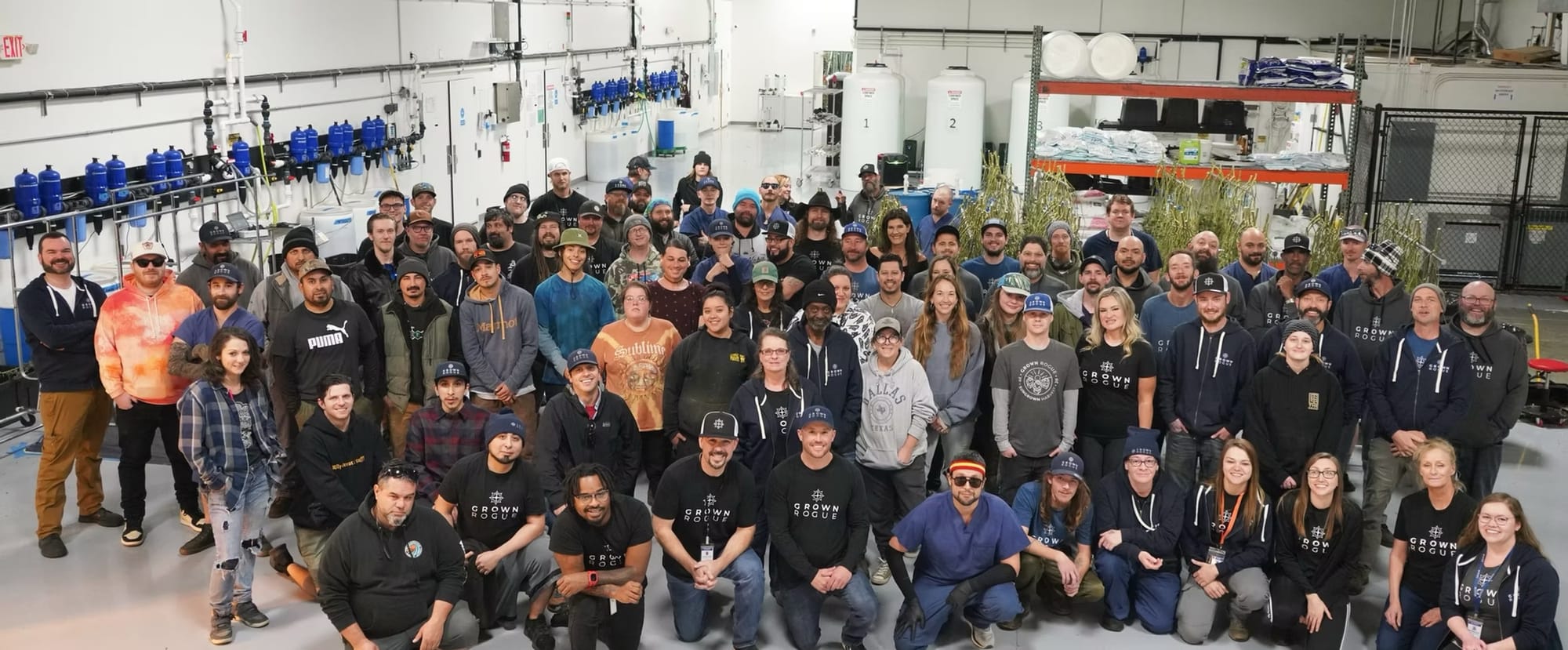
Internally, Grown Rogue describes its team structure in terms that reflect its origins. The organization is built around accountability, repetition, and incremental improvement—concepts drawn as much from athletics as from agriculture. This approach positions the team as an extension of the cultivation process itself: each role contributing to consistency at scale.
The company also emphasizes education and community engagement as part of its broader mission. As legal markets expand, consumer knowledge becomes a factor in product differentiation. Grown Rogue’s focus on flavor, genetics, and cultivation methods aligns with an audience that is increasingly attentive to those details.
Scaling Without Dilution
One of the central challenges in the cannabis industry is maintaining product quality while increasing production volume. Grown Rogue’s model attempts to address that by keeping cultivation at the center of decision-making. Rather than building outward from branding or retail, the company continues to operate from a cultivation-first perspective.
This approach does not eliminate the pressures of scaling—cost, compliance, and competition remain constant—but it defines how those pressures are managed. Each expansion is measured against the same baseline established in the Rogue Valley: whether the final product meets internal standards for quality.
Continuity
Despite growth, the company’s core framework has remained relatively consistent. Genetics, environment, and process continue to guide operations. The emphasis on flavor and experience reflects the founders’ original motivation: to produce cannabis that meets their own expectations.
Grown Rogue’s trajectory—from informal hillside cultivation to multi-state operations—mirrors broader shifts within the industry. Yet its internal logic remains rooted in an earlier period, when quality control depended entirely on the grower.
The context has changed. The standards have not.
