
By Dr. Shawanna E. Vaughn
“Protect Black women.” When protect black woman is only a slogan.
We hear it at rallies. We see it on shirts and social media. Community leaders repeat it from stages and pulpits. Politicians incorporate it into speeches.
But I have learned to ask a different question:
What happens when a Black woman actually needs protecting?
What happens when she says she has been robbed, financially harmed, deceived or left unable to meet her basic obligations? What happens when the people involved are respected in the community, connected to politics, involved with nonprofits or associated with the church?
Does “Protect Black women” remain a principle—or does it become nothing more than a slogan?
For me, these questions are deeply personal.
I am a mother, community advocate and the founder of Silent Cry Inc. I have spent years fighting for people affected by incarceration, trauma, violence and systems that fail to recognize the humanity of the people standing before them.
Now I am asking that same system to recognize mine.
A Previous Experience With the Justice System
Nearly two years ago, I reported being robbed by Robert Olive, a man who had worked as my driver.
My experience with the Wayne County justice system left me feeling that what happened to me was never adequately addressed.
My case went before Judge Austin Garrett. I understood the court to recognize behavior that I found deeply concerning, yet the ultimate outcome included probation and court-mandated programming rather than the level of accountability I believed the circumstances required.
Most importantly for me, I did not receive the restitution I believed I was owed.
I was the person who had experienced the loss, yet I was left trying to put my life back together.
I later experienced a break-in and was again left dealing with the fear and consequences of being victimized. At the same time, I watched people in the community rally around someone I believed had harmed me.
That experience changed the way I hear the phrase “Protect Black women.”
Protection cannot depend upon whether the accused person is popular.
It cannot depend upon his community connections.
It cannot disappear because holding someone accountable would be uncomfortable.
My concerns became even more profound when Olive later became involved in additional serious criminal conduct, including a case involving the shooting of a man.
For me, that raised an important public-safety question:
What happens when troubling behavior is recognized but meaningful intervention does not happen until the behavior becomes even more serious?
Accountability and prevention do not have to be enemies. Sometimes accountability is prevention.
Now I Am Asking for Justice Again
Today I am asking the Wayne County Prosecutor’s Office to take another financial allegation seriously.
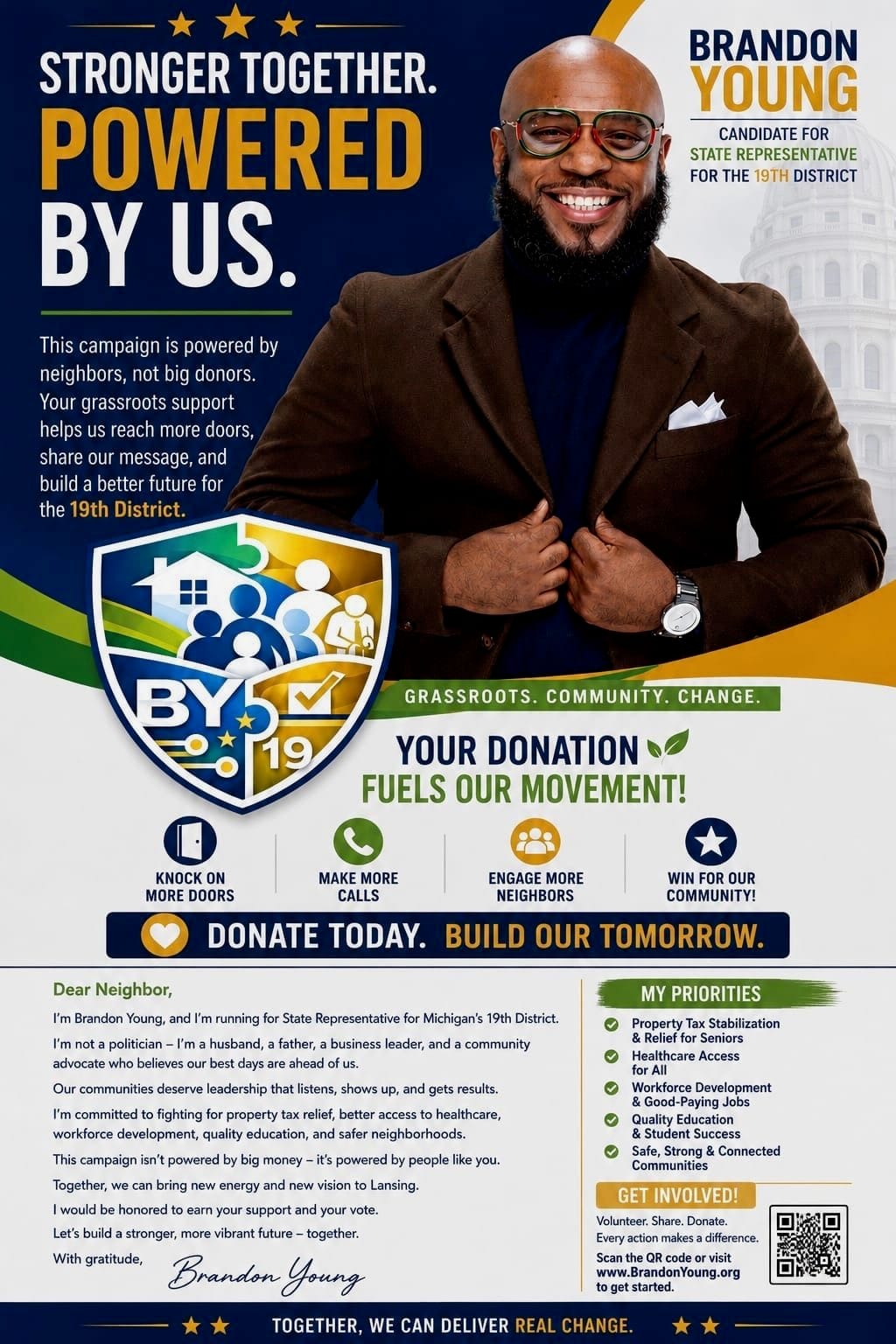
This time, it involves Brandon Young, who ran as a candidate for State Representative in Michigan’s 19th House District.
I was not watching his campaign from the outside.
I was his campaign manager.
I was also intimately involved with him for approximately a year.
I knew the candidate presented to voters as a community-minded person concerned with leadership and integrity. I supported that vision because I believed in the person presenting it.
Now I question nearly every conversation.
I question intentions.
I question promises.
I question what was genuine and what was not.
And I have found myself asking a devastating question:
Was I sleeping with my enemy?
I experienced this relationship as one filled with deception, emotional manipulation and infidelity. Those are my experiences and my characterization of what happened; Young is entitled to his own account.
But the end of a relationship and a financial dispute are two different matters.
People are allowed to leave relationships.
People are allowed to change their minds.
People are allowed to decide that they no longer want to be with someone.
What they are not entitled to do is leave with money that does not belong to them.
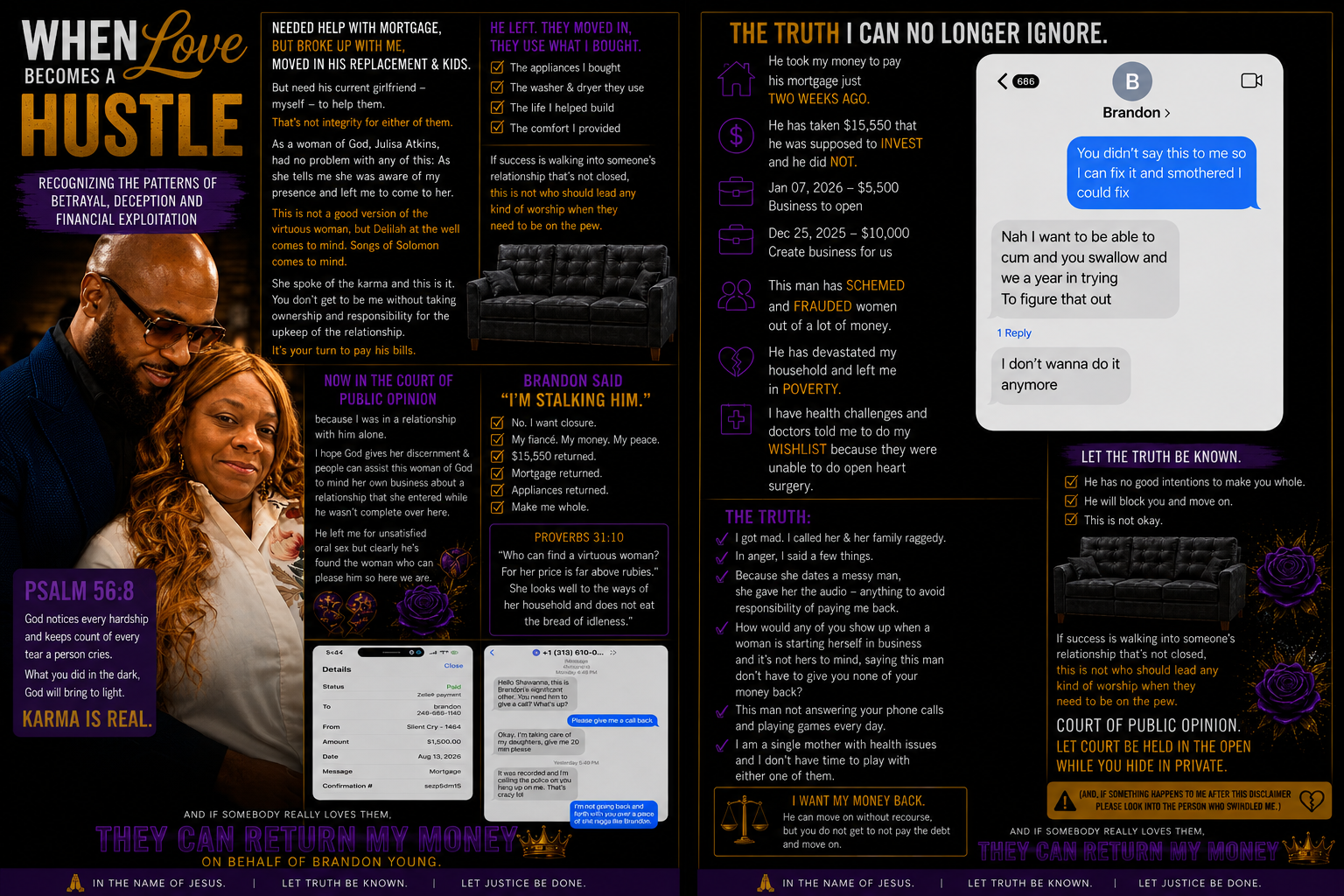
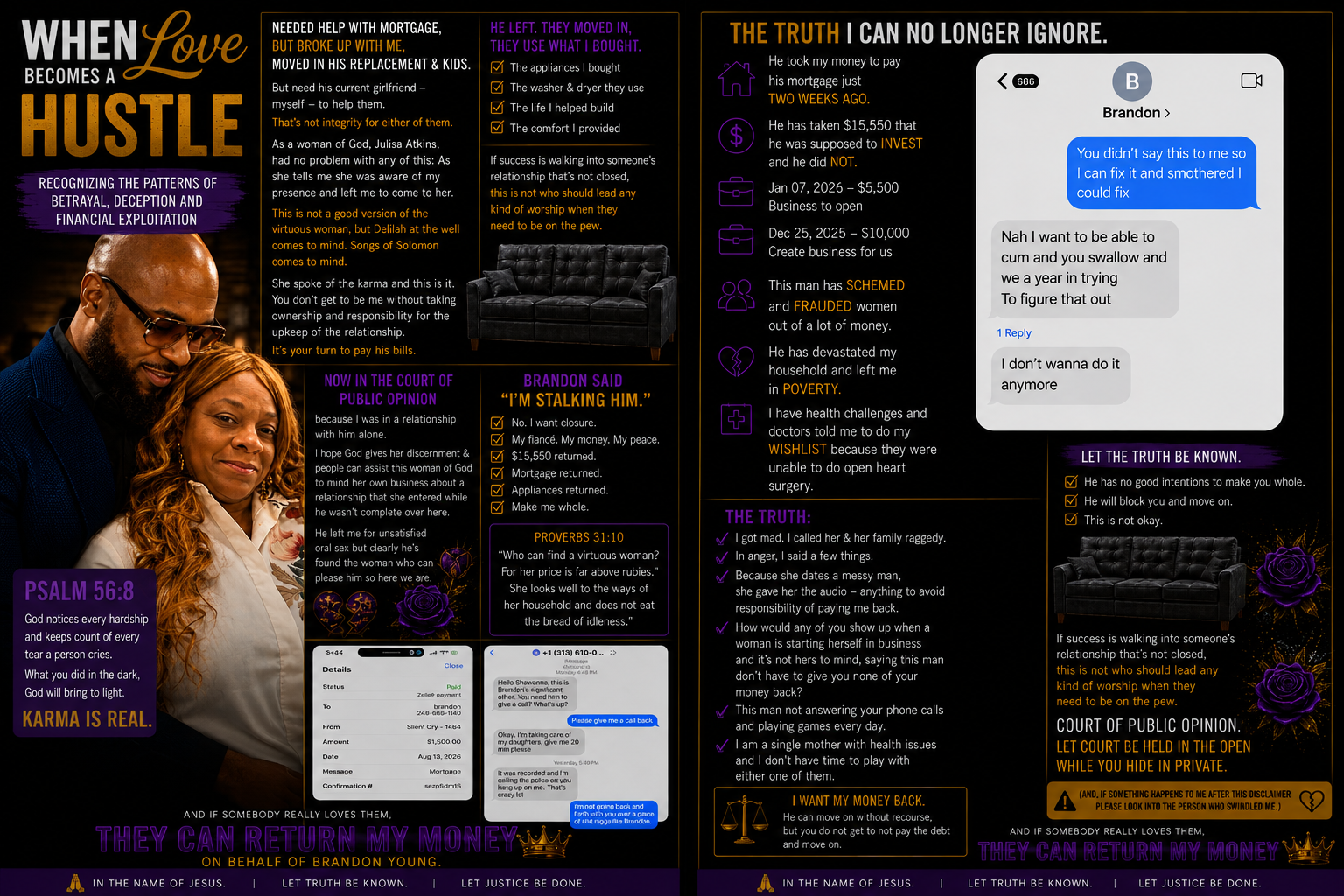
Among the financial transactions I dispute is approximately $15,550 that I say I provided for investment purposes. I am asking investigators to determine what happened to those funds and whether the available evidence supports criminal charges.
I believe the electronic transfers, communications, banking information and other records should be examined.
I am not asking a magazine article to convict Brandon Young.
I am asking the justice system to investigate him.
Whether the conduct legally constitutes wire fraud, another financial offense, a civil dispute or no offense at all is ultimately a determination for the appropriate authorities based upon evidence and applicable law.
But allegations should not receive less scrutiny because the person accused once ran for office.
Integrity Cannot Be a Campaign Slogan Either
Young campaigned to represent Michigan’s 19th House District.
When someone asks voters to entrust them with public office, character matters.
Integrity matters.
Financial responsibility matters.
How someone treats people when there are no cameras around matters.
That is why this experience has caused me to revisit everything I believed.
There can be an enormous difference between someone’s public image and another person’s private experience with them.
The people who cause harm do not necessarily look like villains.
They may be nonprofit board members.
They may work alongside respected community organizations.
They may campaign for office.
They may be business owners.
They may be activists.
They may stand behind pulpits.
They may know every politically correct phrase about justice, equity, community and protecting women.
That public presentation can make it even harder for someone alleging harm to be heard.
Then Another Woman Entered the Story
My experience became more complicated when Ordained Minister Julisa Atkins of Spirit and Truth Church in Detroit entered the situation.
She became involved with Young while, from my perspective, my relationship and financial dispute with him remained unresolved.
In communications with Atkins, I understood her position to be that because I did not have certain paperwork, I would not be able to recover money that I say Young owes me.
I disagree.
My concern is not simply that another woman became involved with a man I loved.
Adults are responsible for choosing their relationships.
My concern is about accountability.
When someone who publicly represents Christian ministry becomes aware that another woman is alleging substantial financial harm, what should the response be?
That is a question worth asking.
We also have to evaluate the pulpit.
Ordination should represent responsibility, compassion and integrity. If a person representing ministry becomes aware of allegations of injustice, I believe the appropriate response should be to encourage truth and accountability—not dismiss the person saying she was harmed.
The church should be willing to examine conduct that conflicts with the values preached from its pulpit.
Some people need to spend more time learning in the pews before assuming the authority of the pulpit.
When Missing Money Becomes a Health Issue
There is another dimension of this story that cannot be separated from the financial one:
My health.
I live with serious health challenges, including a significant heart condition requiring continuing medical care and costly medication.
That changes what financial instability means.
For me, losing access to thousands of dollars isn’t simply about being unable to take a vacation, buy something I want or maintain a particular lifestyle.
It can affect my ability to meet basic life expenses.
Medication.
Housing.
Utilities.
Transportation.
Food.
Family responsibilities.
Medical appointments.
These are not luxuries.
These are social determinants of health.
When financial stability disappears, health can become unstable along with it.
The Heart Can Only Take So Much
People sometimes talk about emotional and financial stress as though they exist only in someone’s mind.
The body experiences stress too.
For someone already dealing with cardiovascular disease, prolonged stress is especially concerning. Stress can influence sleep, blood pressure, heart rate and behaviors that affect cardiovascular health.
I know what this experience feels like inside my own body.
The heart can only take so much.
There comes a point when peace becomes more important than proving you can withstand another crisis.
I am considering relocating because I need peace.
Think about what that means.
I have spent years building community relationships and doing advocacy work, yet I am contemplating uprooting my life because I want to wake up somewhere where my nervous system does not feel like it has to prepare for another battle.
Sometimes relocation isn’t running away.
Sometimes it is choosing survival.
Sometimes it is saying: My body deserves peace too.
Meanwhile, Life Goes On
One of the hardest parts of alleged financial harm is watching the person you believe caused it seemingly continue with life while you absorb the consequences.
From my perspective, Brandon Young appears able to continue living his daily life without the same financial restrictions I am experiencing.
Meanwhile, I am trying to determine how to cover obligations with funds I say should still be available to me.
I am calculating.
Prioritizing.
Rearranging.
Trying to figure out what can wait and what absolutely must be paid.
Trying to protect my household.
Trying to protect my health.
Trying to ensure I have medication.
Trying to remain a mother.
Trying to continue running an organization and serving other people.
Trying to maintain some semblance of peace.
Financial harm creates a ripple effect.
The person accused of causing the loss may continue living normally while the person alleging harm spends months trying to recover financially, physically and emotionally.
That imbalance deserves attention.
This Is Why Financial Exploitation Is Also a Health-Equity Issue
We often discuss health equity as though healthcare begins when someone enters a doctor’s office or hospital.
It begins much earlier.
Health is whether you have stable housing.
Health is whether your electricity remains connected.
Health is whether there is food in your refrigerator.
Health is whether you can afford medication.
Health is whether you have transportation to appointments.
Health is whether you can sleep without wondering which bill will bounce tomorrow.
Health is whether your environment allows your body to rest.
And sometimes health is having enough peace that your body is no longer preparing for the next crisis.
That is why financial victimization deserves to be taken seriously.
For someone who is already medically vulnerable, taking away financial stability can also interfere with the resources that help that person remain healthy.
I am fighting for my money, but I am also fighting for my stability, my health and my peace.
Prosecutor Kim Worthy: I Am Asking for Justice
I am publicly asking Wayne County Prosecutor Kym Worthy and the appropriate investigative authorities to review my complaint and supporting documentation fairly and thoroughly.
I am not asking for special treatment.
I am asking for the system to work.
Examine the transfers.
Examine the messages.
Examine the banking records.
Examine the police reports.
Examine the agreements and communications surrounding the money.
Interview the people involved.
Allow Brandon Young to provide his account.
Then follow the evidence wherever it leads.
If investigators determine that a prosecutable offense occurred, I want accountability.
My previous experience with the justice system left me believing that stronger intervention might have mattered. Watching subsequent serious conduct involving the person I previously accused of robbing me only strengthened my belief that communities cannot wait until behavior escalates before taking it seriously.
We can reduce harmful behavior through solutions.
Accountability can be one of those solutions.
Restitution can be one of those solutions.
Treatment can be one.
Education can be one.
Rehabilitation can be one.
These things can coexist.
Stop Calling Women’s Financial Harm “Relationship Drama”
This distinction is important.
A relationship ending is emotional.
A financial obligation is financial.
The fact that two people were romantically involved should not automatically transform every financial allegation into a private romantic disagreement.
A breakup does not cancel a debt.
A new girlfriend does not cancel a debt.
A political campaign does not cancel a debt.
A nonprofit title does not cancel a debt.
A ministerial title does not cancel a debt.
And being respected in the community does not place anyone beyond investigation.
I can grieve the relationship separately.
I can grieve being deceived separately.
I can question whether the love I believed existed was genuine.
But money entrusted to someone for a specific purpose deserves an accounting independent of whether the romantic relationship survived.
Who Do We Protect?
That brings me back to where this story began.
“Protect Black women.”
Do we mean it?
Because protecting Black women cannot mean protecting us only when the accused person is a stranger.
It cannot mean believing us only when the person we accuse is unpopular.
It cannot mean demanding justice only when doing so costs our community nothing.
Protection has to exist when the accused person is your friend.
Your political candidate.
Your colleague.
Your business partner.
Your nonprofit board member.
Your minister.
Your community leader.
Or someone you love.
Accountability is not betrayal.
Sometimes accountability is the greatest evidence that we actually believe the principles we preach.
I have dedicated much of my life to fighting for people affected by incarceration, trauma and systemic injustice. I believe in second chances. I believe in rehabilitation. I believe that no human being should forever be reduced to their worst decision.
But believing in humanity does not require abandoning accountability.
Victims deserve humanity too.
I Want My Money Back. I Want My Peace Back.
At its core, my request is simple.
I want an investigation.
I want the evidence examined.
I want whatever money is legally determined to belong to me returned.
I want accountability where accountability is supported by the evidence.
And I want peace.
I don’t want my health sacrificed to another person’s choices.
I don’t want to spend my days trying to replace money that I believe should never have disappeared from my life.
I don’t want another woman to discover that slogans about protecting her disappear the moment the person she accuses is popular or connected.
The justice system should not determine whose pain matters based on titles, politics or relationships.
Neither should our communities.
Protect Black women cannot remain something we chant.
It must include protecting our financial stability.
It must include believing that financial harm deserves investigation.
It must include access to healthcare and medication.
It must include restitution when restitution is legally owed.
It must include our physical and emotional health.
It must include our right to peace.
And when the evidence establishes wrongdoing, it must include accountability.
Because justice is not justice if the person harmed is the only person left paying the price.
