
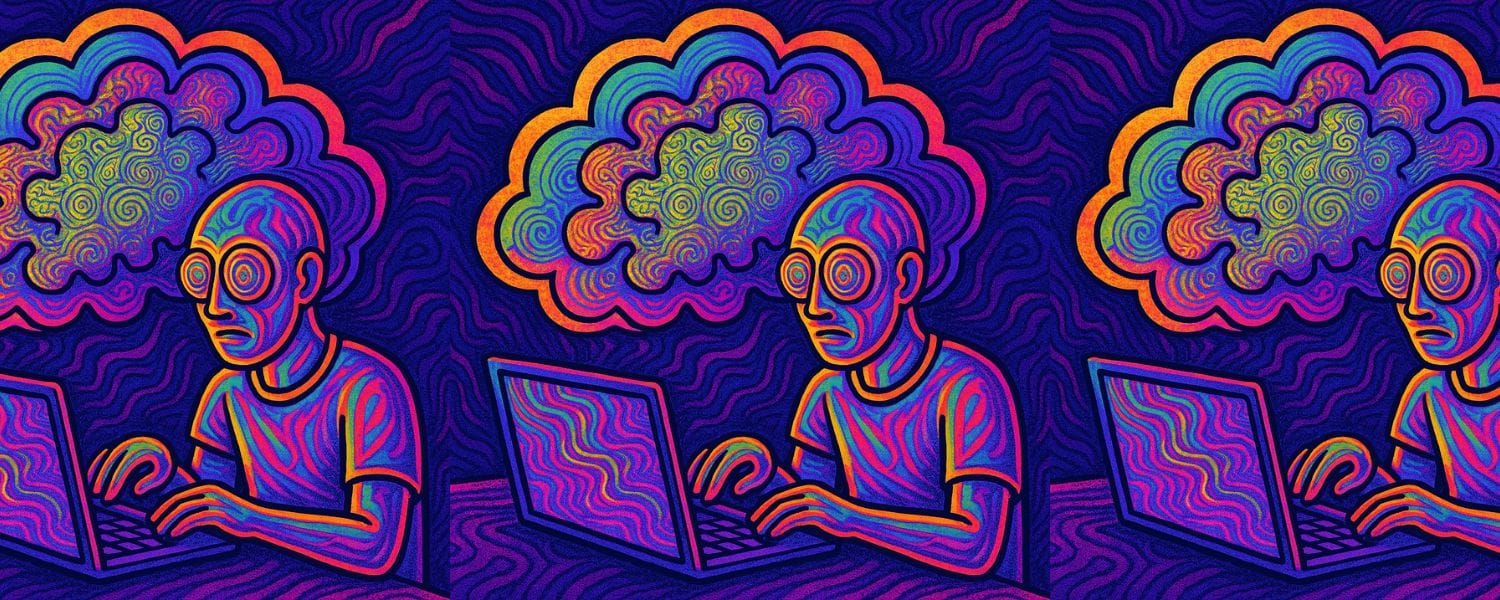

Who Gave the Cloud LSD?
Your AI’s Tripping—and So Is Your Spreadsheet
By Ken Darby
Generative AI is wild. It can help you write, plan, summarize, ideate—even name your next side hustle. But the more you use it, the more you notice something weird…
Like it’s seeing fractals in your finance report.
Like your assistant’s on acid.
Like your AI is hallucinating.
And here’s the thing—it is.
We’re not talking typos or a misplaced comma. We’re talking full-on made-up facts. Fake legal cases. Imaginary stats. Footnotes that look legit but don’t exist. And if you’re not paying attention, this stuff slips right into your work like nothing happened.
How I First Noticed It
When I first started using ChatGPT, I felt what most people felt—fascination, mixed with a strange cocktail of hope and fear.
Maybe that’s because I’ve spent most of my career in public safety. You don’t mess around with tools you don’t understand.
So I kept it light. I asked for healthy meal plans based on what I had in the fridge. Quick hotel-room workouts I could do on the road. I even logged my food in it, thinking I could track what I ate.
By Day 3, I asked it to recap my dinners.
It told me it was Thursday.
It referenced a cookie party I had mentioned—but hadn’t gone to yet. I stared at the screen and typed, “That’s 100% wrong. Today is Tuesday.”
The AI responded calmly, admitted I was right, and updated the log like nothing happened.
That’s when I knew: this thing wasn’t evil—but it sure as hell couldn’t be blindly trusted.
What’s an AI Hallucination?
In plain terms? It’s when AI sounds confident—but it’s dead wrong.
Technically, it’s because models like ChatGPT don’t “know” facts. They predict what text is likely to come next based on patterns from billions of words.
It’s not search. It’s pattern-guessing.
So if your prompt is vague, or if the model hits a gap in its training data, it doesn’t admit ignorance. It improvises—smoothly, persuasively, and dangerously.
It’s like a confident intern who thinks they read the news… and now they’re pitching fake stats in the Monday leadership meeting.
Real-World Trips: AI Hallucinations in the Wild
👨⚖️ Objection! Those Cases Aren’t Real
In Mata v. Avianca, Inc. (2023), a lawyer used AI to draft a legal brief that cited six court cases. Problem? None of them existed. The judge sanctioned him, and it made national headlines.
🎓 Academic Ghost Stories
Students are submitting essays with footnotes to made-up journals and studies. A 2024 Oxford University report flagged this trend, leading some professors to require source-verification assignments.
📈 Business Blunders
AI-generated reports are spitting out fake market stats. Gartner has warned that over-relying on AI for analytics—without fact-checking—could lead to disastrous business calls and financial losses.
Why It Happens (And Why It’s Not Lying)
It’s not lying. It’s just doing what it was designed to do.
These tools aren’t search engines. They’re language models trained to predict the next most likely word. When the data is incomplete, they fill in the blanks.
They were built to sound fluent, not to be factual.
So if the model doesn’t know the answer, it makes up something that sounds like the answer.
What’s Being Done About It?
The tech industry is scrambling to reduce hallucinations, but there’s no silver bullet. Current approaches include:
- Retrieval-Augmented Generation (RAG): AI pulls info from external sources while writing. Promising, but only as good as the data it pulls.
- Verification Models: One AI double-checks another’s output. Helps—unless both are wrong.
- Live Citations: Some models link sources in real time, but those links can still point to unreliable material.
- Better Training Data: Using peer-reviewed sources over internet chatter. Effective but expensive and imperfect.
- Human Feedback: AI learns from corrections—but only when users catch errors.
Even with all this, Stanford’s 2024 study found hallucination rates still hover between 10% and 20%, especially in fields like law, medicine, and finance.
What You Can Do Right Now
- ✅ Verify everything. If it sounds genius, Google it.
- 🔎 Ask for sources. And actually check the links.
- ⚠️ Be skeptical of confidence. AI doesn’t hedge—it performs.
- ✍️ Use it as a starting point. Draft with it, don’t let it publish for you.
Final Word
Generative AI is powerful. It’s fast. It’s clever.
But it’s not reliable. Not yet.
It should never be making decisions for you unsupervised.
The good news? You can use it right. Keep it in the passenger seat—not the driver’s.
Because someone may have slipped something into the cloud…
…and your spreadsheet already knows it.
