
For decades, cannabis existed in a contradiction.
On paper, it was one of the most dangerous substances in America—classified alongside heroin, defined as having no accepted medical use. In reality, it was already woven into daily life: prescribed by doctors, sold in licensed storefronts, researched in labs, and embedded in culture from New York to Tel Aviv.
This week, the federal government finally acknowledged that gap.
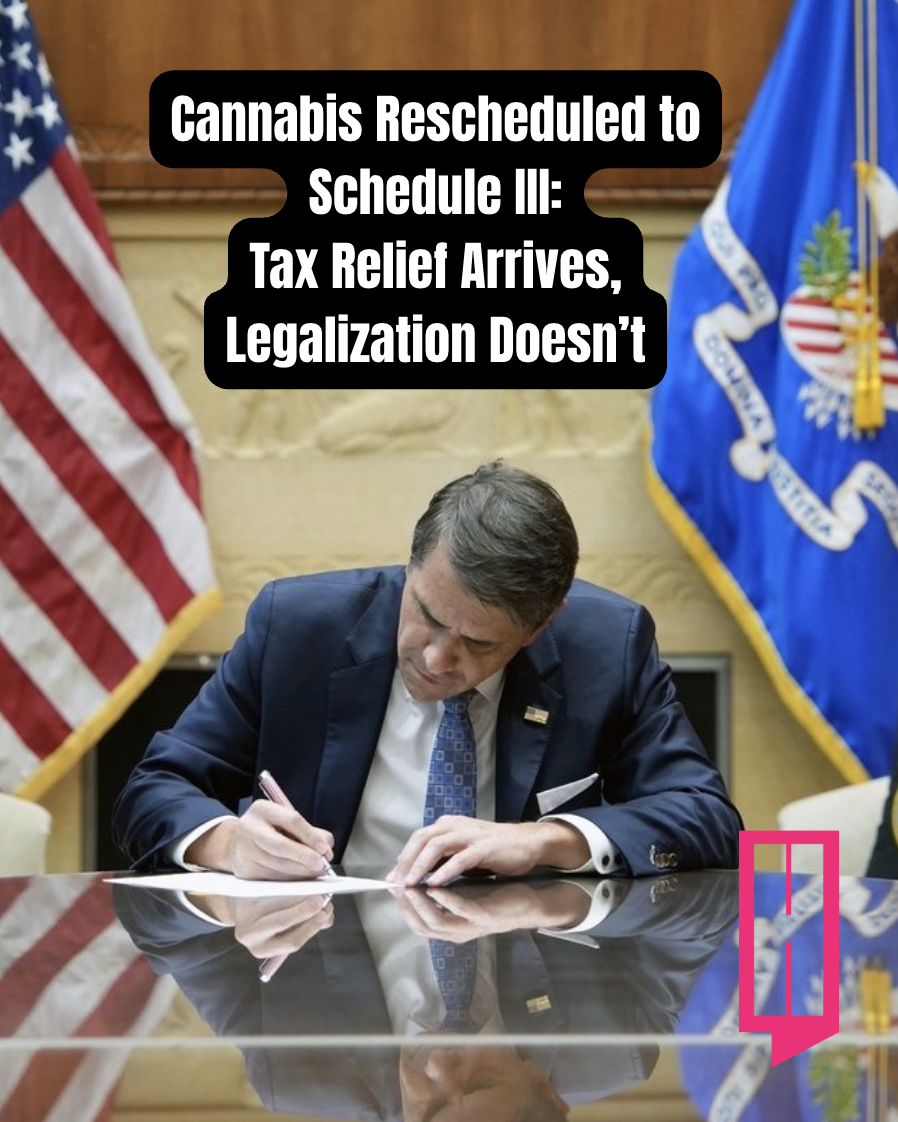
In a move that may prove to be one of the most consequential policy shifts of the modern era, the Trump administration has reclassified state-licensed medical marijuana from Schedule I to Schedule III under the Controlled Substances Act. The order, signed by Acting Attorney General Todd Blanche, doesn’t legalize cannabis. It doesn’t unify the fractured state-by-state system. But it does something that Washington resisted for more than half a century—it recognizes that cannabis has medical value.
That recognition alone changes everything.
Quietly, but decisively, the foundation has shifted. A substance once defined by prohibition is now categorized among drugs with accepted medical use and moderate risk. It’s a bureaucratic change, but one that carries real-world consequences—from how research is conducted to how businesses operate to how the plant itself is perceived.
For the industry, the most immediate impact may not be symbolic at all. It’s financial.
“Today’s decision is a meaningful validation of the growing body of scientific evidence supporting cannabis’ therapeutic potential. Rescheduling to Schedule III will help expand clinical research, improve patient access to regulated, high-quality treatments, and further integrate cannabis into mainstream healthcare conversations. While this is first and foremost a win for patients, it also lays the groundwork for a more sustainable and responsible industry moving forward.” - Dave Vautrin, CEO FLUENT Cannabis.
For years, cannabis operators have lived under the weight of IRS Code 280E, a relic of prohibition-era logic that prevented them from deducting ordinary business expenses. The result was punishing—tax rates that could climb past 70%, making profitability nearly impossible even in thriving markets. With the move to Schedule III, that burden begins to lift. Companies can now operate more like actual businesses, not legal anomalies. Margins expand. Capital becomes more viable. Growth, for the first time in a long time, feels structurally supported.
But the shift is not without tension.
Critics have already framed the move as a quiet handoff of advantage to large-scale operators—a “tax break to Big Weed,” as one opponent described it—raising familiar questions about who benefits when policy finally catches up to culture.
At the same time, the federal government is careful to maintain its grip. Cannabis remains illegal at the federal level. Recreational markets are untouched. Interstate commerce is still off-limits. And anything outside of state-licensed medical frameworks remains firmly in Schedule I.
In other words, the system hasn’t been rebuilt. It’s been adjusted.
Where the shift may resonate most deeply is in science. For researchers, cannabis has long been trapped behind regulatory barriers that made serious study difficult, if not impossible. That begins to change now. With fewer restrictions and clearer pathways, scientists can finally engage with cannabis in a way that reflects its real-world use—studying safety, efficacy, and long-term impact without the same bureaucratic friction. The Department of Justice framed the move as a step toward better data, better care, and a more grounded understanding of the plant.
And yet, even this moment comes with an asterisk.
The administration has already signaled that this is not the final word. A formal hearing process, set to begin in late June, will examine whether cannabis should be fully rescheduled beyond the medical framework. It’s a continuation of a process that began under the previous administration, now accelerated under Trump’s directive to move “as quickly as possible.”
So the industry finds itself in a familiar position—on the edge of something larger, but not quite there.
What makes this moment different is the tone. For the first time, the federal government is no longer arguing that cannabis has no place in medicine. That argument is over. The question now is how far that acknowledgment will go—and how quickly the rest of the system will catch up.
Because cannabis doesn’t exist in theory anymore. It exists in markets, in labs, in culture, in global conversations that extend far beyond U.S. borders. The rescheduling doesn’t create that reality—it simply recognizes it.
Halfway.
And in an industry built on navigating gray areas, halfway can still be a turning point.
