
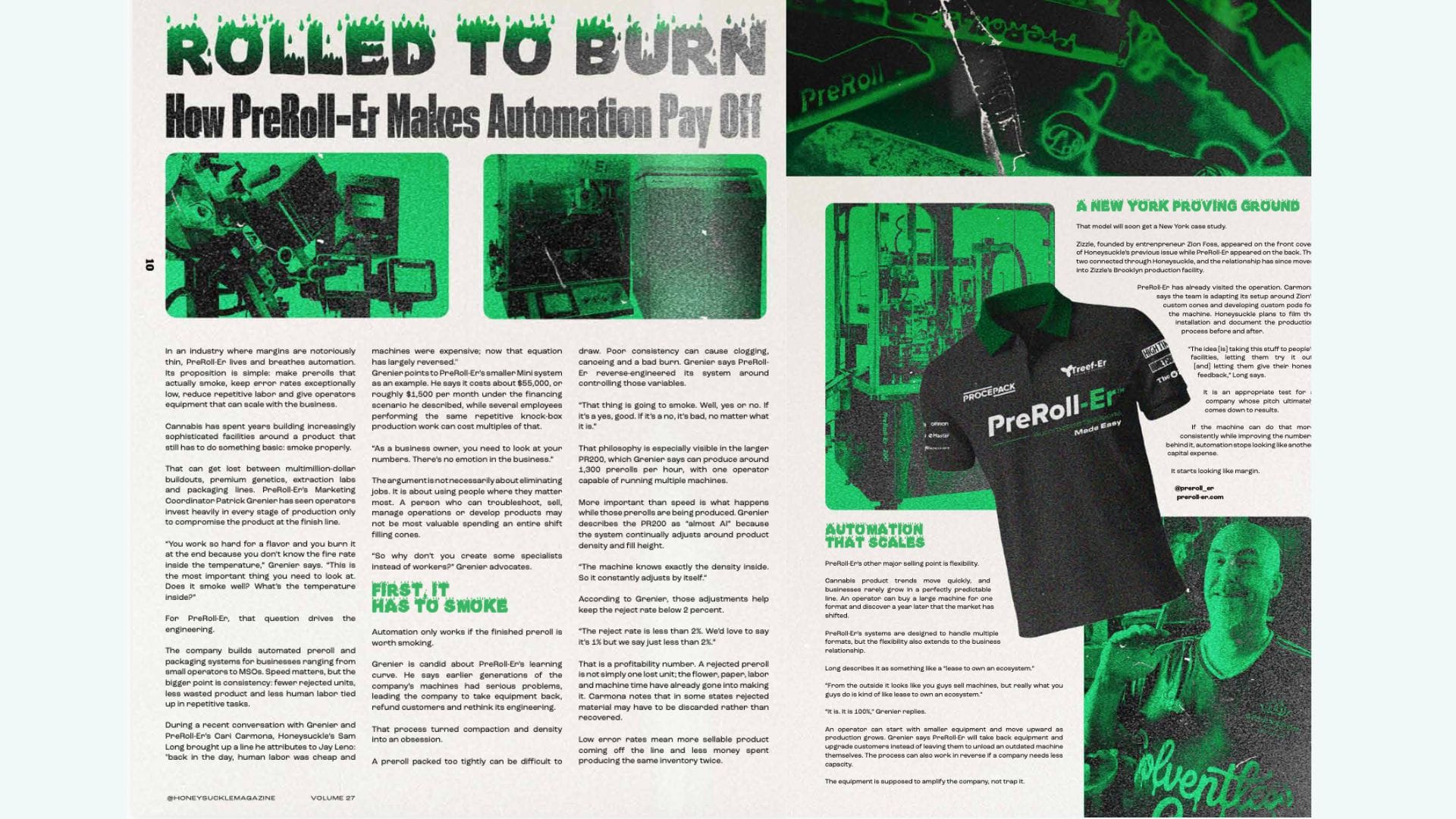
In an industry where margins are notoriously thin, PreRoll-Er lives and breathes automation. Its proposition is simple: make prerolls that actually smoke, keep error rates exceptionally low, reduce repetitive labor and give operators equipment that can scale with the business.
Cannabis has spent years building increasingly sophisticated facilities around a product that still has to do something basic: smoke properly.
That can get lost between multimillion-dollar buildouts, premium genetics, extraction labs and packaging lines. PreRoll-Er’s Patrick Grenier has seen operators invest heavily in every stage of production only to compromise the product at the finish line.
“You work so hard for a flavor and you burn it at the end because you don’t know the fire rate inside the temperature,” Grenier says. “This is the most important thing you need to look at. Does it smoke well? What’s the temperature inside?”
For PreRoll-Er, that question drives the engineering.
The company builds automated preroll and packaging systems for businesses ranging from small operators to MSOs. Speed matters, but the bigger point is consistency: fewer rejected units, less wasted product and less human labor tied up in repetitive tasks.
During a recent conversation with Grenier and PreRoll-Er’s Cari Carmona, Honeysuckle’s Sam Long brought up a line he attributes to Jay Leno: back in the day, human labor was cheap and machines were expensive; now that equation has largely reversed.
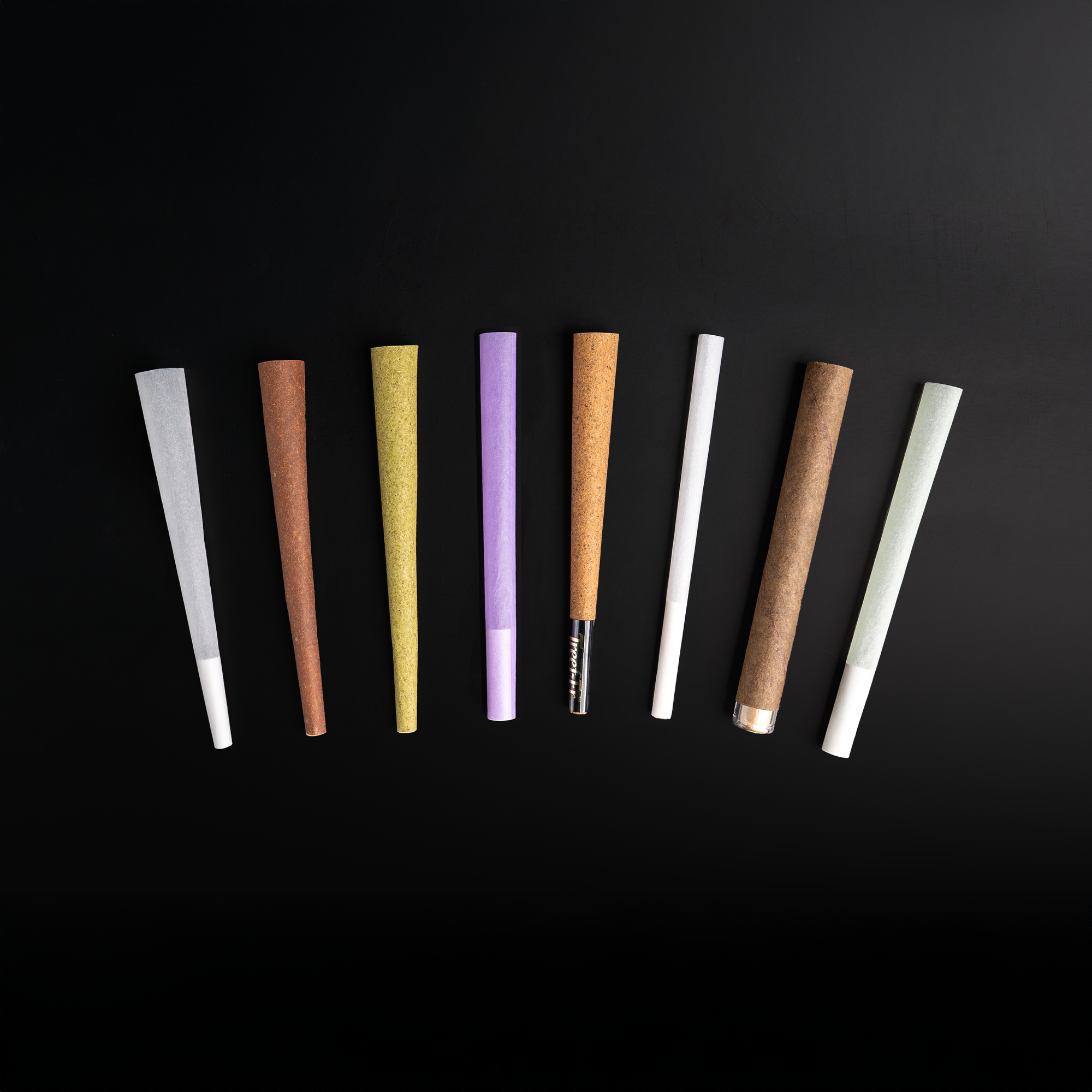
Grenier points to PreRoll-Er’s smaller Mini system as an example. He says it costs about $55,000, or roughly $1,500 per month under the financing scenario he described, while several employees performing the same repetitive knock-box production work can cost multiples of that.
“As a business owner, you need to look at your numbers. There’s no emotion in the business.”
The argument is not necessarily about eliminating jobs. It is about using people where they matter most. A person who can troubleshoot, sell, manage operations or develop products may not be most valuable spending an entire shift filling cones.
“So why don’t you create some specialists instead of workers?” Grenier asks.
First, It Has to Smoke
Automation only works if the finished preroll is worth smoking.
Grenier is candid about PreRoll-Er’s learning curve. He says earlier generations of the company’s machines had serious problems, leading the company to take equipment back, refund customers and rethink its engineering.
That process turned compaction and density into an obsession.
A preroll packed too tightly can be difficult to draw. Poor consistency can cause clogging, canoeing and a bad burn. Grenier says PreRoll-Er reverse-engineered its system around controlling those variables.
“That thing is going to smoke. Well, yes or no. If it’s a yes, good. If it’s a no, it’s bad, no matter what it is.”
That philosophy is especially visible in the larger PR200, which Grenier says can produce around 1,300 prerolls per hour, with one operator capable of running multiple machines.
More important than speed is what happens while those prerolls are being produced. Grenier describes the PR200 as “almost AI” because the system continually adjusts around product density and fill height.
“The machine knows exactly the density inside. So it constantly adjusts by itself.”
According to Grenier, those adjustments help keep the reject rate below 2 percent.
“The reject rate is less than 2%. We’d love to say it’s 1% but we say just less than 2%.”
That is a profitability number. A rejected preroll is not simply one lost unit; the flower, paper, labor and machine time have already gone into making it. Carmona notes that in some states rejected material may have to be discarded rather than recovered.
Low error rates mean more sellable product coming off the line and less money spent producing the same inventory twice.
Automation That Scales
PreRoll-Er’s other major selling point is flexibility.
Cannabis product trends move quickly, and businesses rarely grow in a perfectly predictable line. An operator can buy a large machine for one format and discover a year later that the market has shifted.
PreRoll-Er’s systems are designed to handle multiple formats, but the flexibility also extends to the business relationship.
Long described it as something like a “lease to own an ecosystem.”
“From the outside it looks like you guys sell machines, but really what you guys do is kind of like lease to own an ecosystem.”
“It is. It is 100%,” Grenier replied.
An operator can start with smaller equipment and move upward as production grows. Grenier says PreRoll-Er will take back equipment and upgrade customers instead of leaving them to unload an outdated machine themselves. The process can also work in reverse if a company needs less capacity.
The equipment is supposed to amplify the company, not trap it.
A New York Proving Ground
That model will soon get a New York case study.
Zizzle, founded by Zion, appeared on the front cover of Honeysuckle’s previous issue while PreRoll-Er appeared on the back. The two connected through Honeysuckle, and the relationship has since moved into Zizzle’s Brooklyn production facility.
PreRoll-Er has already visited the operation. Carmona says the team is adapting its setup around Zion’s custom cones and developing custom pods for the machine. Honeysuckle plans to film the installation and document the production process before and after.
“The idea of taking this stuff to people’s facilities, letting them try it out, letting them give their honest feedback,” Long says.
It is an appropriate test for a company whose pitch ultimately comes down to results.
If the machine can do that more consistently while improving the numbers behind it, automation stops looking like another capital expense.
It starts looking like margin. Read more about Preroll-Er in our current print edition!
For more follow https://preroll-er.com and Instagram.
