
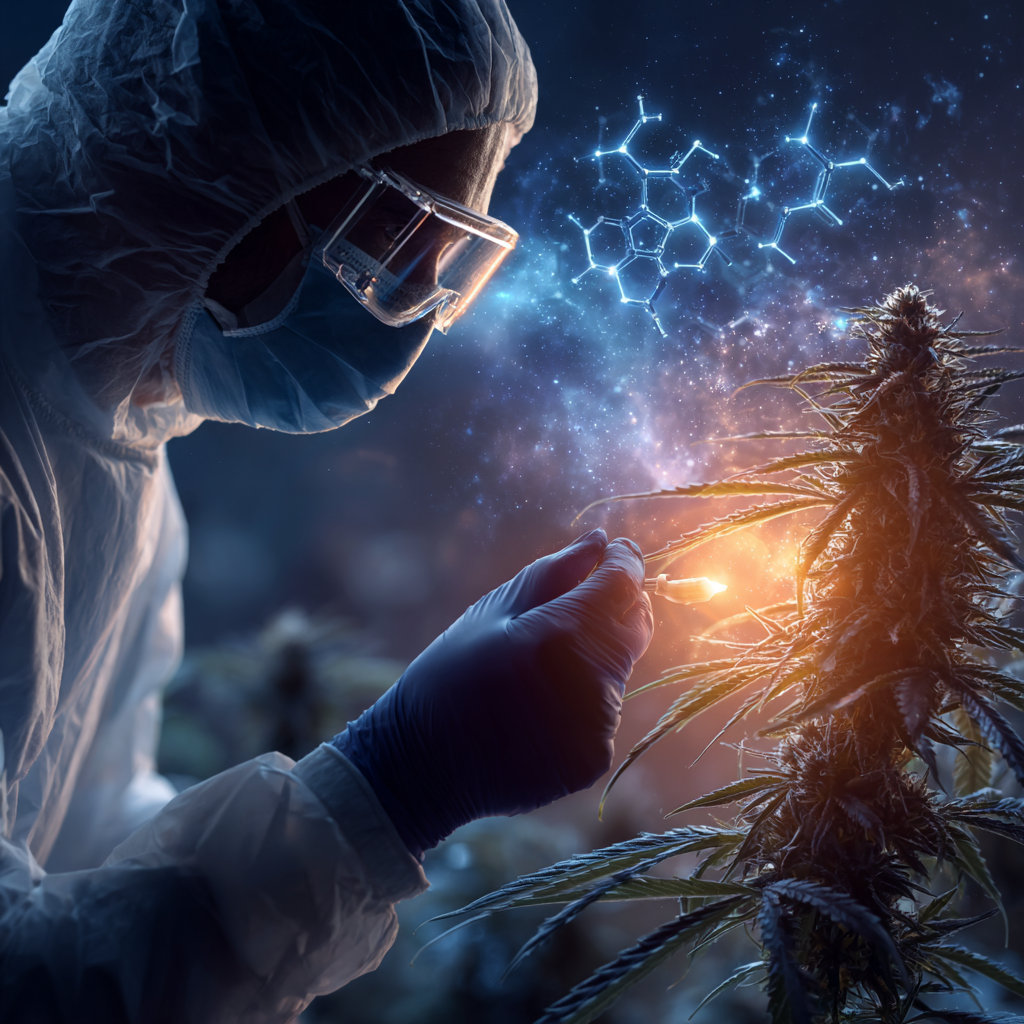

Inside the molecular universe scientists are only beginning to understand. Scientists have identified more than 550 compounds in the cannabis plant. From cannabinoids and terpenes to biotechnology, researchers are uncovering a complex molecular system.
The Future of Precision Cannabis Medicine
Scientists are discovering that the cannabis plant contains one of the most complex chemical systems found in nature, with hundreds of compounds including cannabinoids, terpenes, and other bioactive molecules.
As knowledge of cannabis chemistry expands, researchers are beginning to imagine a new model of medicine—one rooted not in single molecules, but in carefully balanced combinations of plant compounds.
Instead of prescribing generic cannabis products, doctors may one day prescribe formulations designed around precise ratios of cannabinoids and terpenes, tailored to the biology of individual patients. Rather than focusing on a single active ingredient, treatments could harness the plant’s full chemical complexity.
These formulations could potentially address conditions such as:
• chronic pain
• neurological disorders
• autoimmune diseases
• inflammatory conditions
• sleep disorders
In this emerging model, cannabis functions less like a single drug and more like a complex pharmacological toolkit—a plant whose chemistry can be tuned and refined to produce highly specific effects.
It’s a dramatic shift from the way cannabis was understood for decades. For much of modern history, the plant was reduced to one molecule: THC. Today, scientists are discovering something far more intricate.
One of the most common questions researchers ask is simple: how many compounds are in the cannabis plant? Modern studies have identified more than 550 different chemical compounds.
A Molecular Universe Still Being Discovered
For a plant cultivated by humans for thousands of years, cannabis still holds an extraordinary number of secrets.
Inside its resinous flowers lies a dense molecular universe—hundreds of compounds interacting through intricate biochemical pathways. What once seemed like a simple botanical intoxicant is increasingly understood as one of the most chemically complex medicinal plants studied by modern science.
Researchers have already identified more than 550 distinct compounds in cannabis, including well over one hundred cannabinoids alongside terpenes, flavonoids, fatty acids, and other secondary metabolites.
Together, these molecules form an interconnected biochemical ecosystem that shapes everything from aroma and flavor to biological activity inside the human body.
The deeper scientists look into cannabis chemistry, the more complexity emerges. And the work has only just begun.
A Plant Full of Molecules
The modern era of cannabis chemistry began in 1964, when Israeli chemist Raphael Mechoulam and his colleagues first isolated tetrahydrocannabinol (THC), the compound responsible for the plant’s psychoactive effects.
That discovery fundamentally changed how scientists understood cannabis. By identifying THC’s structure, researchers were able to investigate how cannabinoids interact with the human body.
Decades later, this work led to the discovery of the endocannabinoid system, a network of receptors found throughout the brain and body that helps regulate mood, appetite, pain perception, immune responses, and neurological signaling.
Mechoulam often described cannabis as an enormous scientific opportunity waiting to be explored.
“Cannabis is a medicinal treasure trove waiting to be discovered.”
Today scientists know THC is just one member of a much larger family.
Cannabis produces a wide array of cannabinoids including CBD, CBG, CBC, THCV, and CBN, each interacting differently with the body’s biological systems. Many of these compounds appear only in small concentrations, but researchers increasingly suspect they may hold important therapeutic potential.
In other words, the plant once associated with a single intoxicating molecule may actually represent an entire pharmacological library.
The Aromatic Language of Terpenes
While cannabinoids dominate public attention, another class of compounds plays a critical role in shaping the cannabis experience: terpenes.
These aromatic molecules are responsible for the distinctive scents associated with different cannabis varieties—citrus, pine, lavender, diesel, tropical fruit. More than one hundred terpene compounds have been identified in the plant.
In nature, terpenes serve as part of the plant’s survival strategy. They can repel insects, attract pollinators, and protect against environmental stress.
But researchers now believe they may also influence how cannabis interacts with the human body.
Neurologist and cannabis researcher Ethan Russo has spent years studying how cannabinoids and terpenes work together. His research helped popularize a concept known as the entourage effect.
“Cannabis works best as a botanical medicine,” Russo has said. “Its components interact in ways that enhance therapeutic effects.”
The theory suggests cannabinoids, terpenes, and other plant compounds may work synergistically—producing effects that differ from those of any isolated molecule.
This could explain why two cannabis varieties with identical THC levels can feel completely different.
The chemistry of cannabis is not linear. It is combinatorial.
The Breeder’s Perspective
While scientists analyze cannabis chemistry in laboratories, breeders experience it through genetics.
For many years, cultivation focused primarily on increasing THC potency. But as understanding of the plant’s chemistry expanded, breeders began shifting their attention toward terpene expression and chemical diversity.
Legendary breeder Derry Brett, founder of Barney’s Farm, has long emphasized that cannabis cannot be reduced to a single metric.
“Cannabis is about the whole profile — cannabinoids, terpenes, and how they express themselves together.”
Modern breeding programs now focus on chemotype development, selecting plants for unique terpene combinations and rare cannabinoid production.
The result has been a dramatic expansion of flavor profiles and aromatic diversity within cannabis genetics worldwide.
The simple categories once used to describe the plant—indica and sativa—are increasingly giving way to a more sophisticated understanding based on chemical composition.
The Hidden World of Secondary Metabolites
Beyond cannabinoids and terpenes lies another layer of cannabis chemistry: secondary metabolites.
These molecules are produced by plants as part of their interaction with the environment rather than basic metabolic processes. They help plants defend themselves from predators, respond to stress, and communicate with surrounding ecosystems.
In cannabis, these compounds include:
• flavonoids
• phenolic compounds
• polyphenols
• fatty acids
• alkaloids
Some of these molecules remain poorly studied, but early research suggests they may contribute to cannabis’s broader biological effects.
One group of compounds unique to cannabis, known as cannaflavins, has demonstrated strong anti-inflammatory potential in preliminary studies.
Each new layer of chemical discovery expands the plant’s scientific significance.
The Rise of Rare Cannabinoids
In recent years, researchers have become increasingly interested in minor cannabinoids—compounds present in small quantities but with potentially unique biological activity.
Among the cannabinoids attracting attention are:
• CBG (cannabigerol) – often called the “mother cannabinoid”
• THCV (tetrahydrocannabivarin) – being studied for metabolic effects
• CBC (cannabichromene) – linked to anti-inflammatory research
• CBN (cannabinol) – explored for sleep and neuroprotective potential
Historically these compounds were difficult to study because they appear only in trace amounts within the plant.
But advances in analytical chemistry and extraction technologies are making them easier to isolate and investigate.
Some scientists believe these molecules may eventually lead to entirely new classes of therapeutic treatments.
Biotechnology Enters the Scene
Another frontier shaping the future of cannabis chemistry is biotechnology.
Scientists are now using synthetic biology to produce cannabinoids through microbial fermentation. By engineering yeast or bacteria, researchers can program microorganisms to produce cannabinoids without growing the plant itself.
This technology could allow:
• scalable production of rare cannabinoids
• pharmaceutical-grade purity and consistency
• discovery of new cannabinoid analogues
Biotech companies are already exploring molecules similar to naturally occurring cannabinoids but modified slightly to produce different therapeutic effects.
In this way, cannabis chemistry may expand far beyond the plant that originally produced it.
Mapping the Cannabis Genome
Genomics is also transforming cannabis research.
For centuries, breeding relied largely on observation and experimentation. Today scientists are sequencing cannabis genomes to identify the genes responsible for cannabinoid and terpene production.
These genetic maps reveal:
• terpene synthase pathways
• cannabinoid biosynthesis genes
• disease resistance traits
• environmental adaptation markers
With this knowledge, breeders can develop new cultivars designed to express specific chemical profiles.
In the future, cannabis genetics may be engineered with the same precision used in pharmaceutical research.
A Plant We Are Only Beginning to Understand
For thousands of years, humans cultivated cannabis without fully understanding its chemistry.
Now modern science is beginning to reveal the extraordinary complexity hidden inside the plant’s resin glands.
What once appeared to be a simple intoxicant is emerging as one of the most chemically sophisticated organisms humans have ever domesticated.
Inside its flowers lies a vast molecular universe—hundreds of interacting compounds that shape aroma, flavor, and biological effects in ways scientists are only starting to decode.
As research continues across fields ranging from genetics and biotechnology to pharmacology and plant science, one thing is becoming increasingly clear:
We are still only at the beginning of understanding what cannabis truly is. And what it may one day become.
