
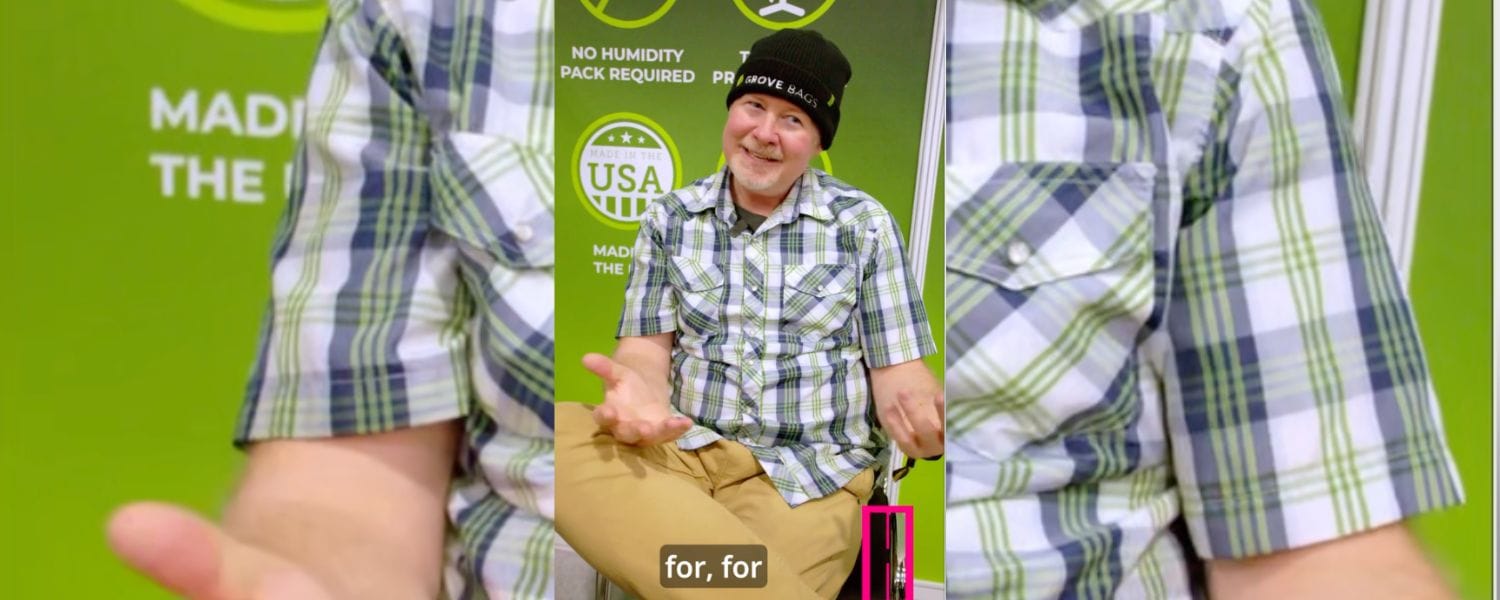

At Cannafest Prague, one of Europe’s longest-running cannabis and hemp trade shows, we sat down with Lance Lambert, Chief Marketing Officer of Grove Bags, to talk about curing, consistency, and why the most impactful innovations in cannabis often focus on making growers’ lives easier.
Grove Bags isn’t a new name to cultivators, but the company’s approach continues to quietly reshape post-harvest workflows across both traditional and regulated markets worldwide.
From Burping Jars to Auto-Curing
Founded nearly a decade ago, Grove Bags was built around a deceptively simple concept: modified atmosphere packaging designed specifically for cannabis. The bags maintain an internal relative humidity range of 58–62%, widely considered the sweet spot for curing flower.

For growers, the process is straightforward. After a standard dry—whether that’s the classic 60/60 method or another routine—the flower is trimmed, placed into a Grove Bag, sealed (ideally with a heat seal), and left alone.
“No more burping jars, no more babysitting,” Lambert explains. “You put it in, seal it, and it auto-cures.”
The difference is more than convenience. Traditional glass jars, totes, or turkey bags require repeated opening, manual humidity management, and constant monitoring—steps that become exponentially more complicated at scale. Grove Bags remove those variables, helping preserve terpene profiles, potency, and overall consistency without daily intervention.
A Grower’s Tool, Not a Gimmick
Lambert speaks as both an executive and a longtime home grower. Like many in the industry, he learned cultivation through legacy methods passed down by “old heads” who swore by glass. Grove Bags challenged that orthodoxy by offering a scalable alternative that doesn’t disrupt the curing environment every time it’s opened.
“For me, as a home grower, the appeal was simple,” he says. “I don’t have to keep opening jars, worrying about forgetting lids, or overhandling the flower.”
That same logic carries over to commercial operations. Grove Bags are now used by an international roster of cultivators, including Preferred Gardens, Doja International Brands (one of the largest licensed producers in Holland), legacy California operators like Wow Town and SoCal, and Calipo Arc Farms in England.
Despite the global reach, Lambert emphasizes that Grove Bags’ value proposition remains grounded in cultivation, not marketing hype.
“First and foremost, everyone we work with is a grower,” he says. “The product makes their lives easier—and the quality, consistency, and potency speak for themselves.”
A Personal History Rooted in Cannabis
Lambert’s relationship with cannabis long predates his role at Grove Bags. A Gen-Xer who grew up during the height of the War on Drugs, he describes a generation shaped by contradiction—where cannabis was culturally present yet criminalized.
“Candidly, cannabis helped me save up for college,” he says. “My partner smoked his profits. I put mine in the bank—that paid for my first year of school.”
His career eventually led him into advertising and media, before circling back to the plant itself. By 2017, Lambert says he was fully “out of the green closet,” advocating openly for cannabis and its role in culture, medicine, and industry.
That background informs how he approaches his work today: not as a trend-chaser, but as someone deeply invested in practical, plant-first solutions.
Carrying Quality Through to the Consumer
While Grove Bags are designed with cultivators in mind, the benefits don’t stop at the grow room. For consumers, the same controlled environment that protects flower during curing also helps preserve freshness after purchase—extending shelf life without relying on added humidity packs or constant adjustments.
“It carries over,” Lambert notes. “When you start with better curing, everything downstream improves.”
At a time when cannabis markets are increasingly competitive and margin-sensitive, tools that improve efficiency without compromising quality are no longer optional. Grove Bags’ continued adoption across continents suggests that sometimes the most transformative innovations aren’t flashy—they’re functional.
And in an industry built on the plant, that might be exactly the point.
For more, visit grove bags.com and Instagram
