

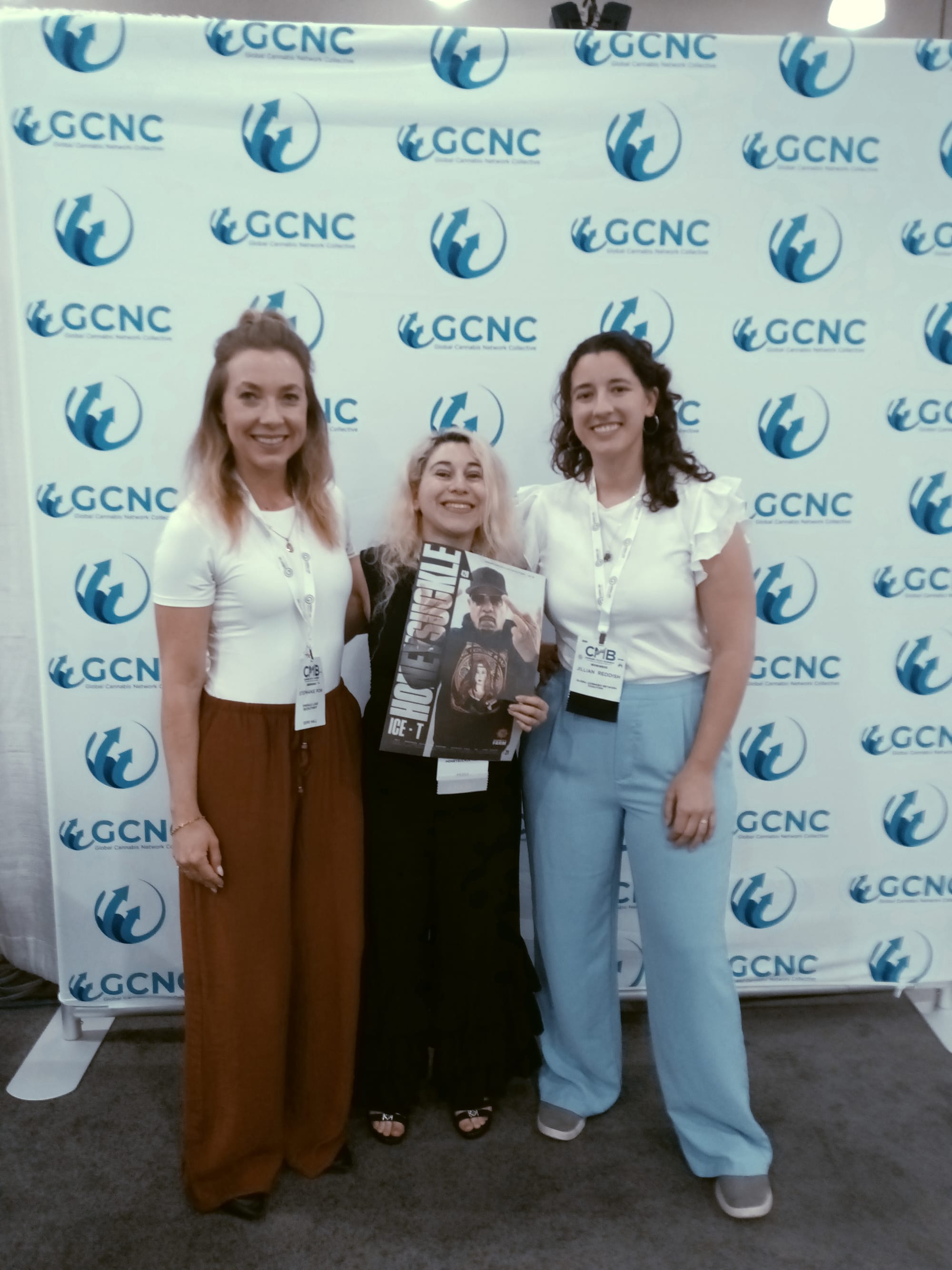
At the 2025 Cannabis Means Business (CMB) Expo in New York—one of North America’s largest and oldest cannabis trade shows—Honeysuckle sat down with Jill Reddish, co-founder of the Global Cannabis Network Collective (GCNC), to talk about the ever-evolving international cannabis industry and how her organization is creating vital connections across the global supply chain. GCNC is known as the premier membership network for C-suite knowledge share, market expansion and international connection among plant-touching and ancillary businesses. It counts among its members such market leaders as Emerald Lane Recruitment, Boveda, Clever Leaves, the Global Cannabis Exchange, and Franny’s Farmacy.
Founded by Reddish and Chris Day, GCNC has become a force in crafting international partnerships. “We have members all over the world,” Reddish explained, “and we work hard to create business development opportunities and targeted networking across every aspect of the supply chain. That’s what GCNC is all about: Bringing people together, connecting ideas and opportunities in meaningful ways.”
A master communicator with a background in marketing and community-building, Reddish brings a unique clarity and purpose to the challenge of scaling cannabis globally through networks that empower, educate, and elevate.
This year, GCNC partnered with the CMB team to help expand the conference’s international programming, adding panels on global investment, cannabis tourism, and how American entrepreneurs can think beyond U.S. borders.
“New York is such an international hub,” Reddish noted. “It only made sense that the event should reflect that global outlook.”

From MJBiz To Global Vision
Before launching GCNC, Reddish and Day both held longtime leadership positions at MJBiz Daily, and were deeply involved in building MJBizCon, now the world’s most expansive B2B cannabis conference, into an industrial powerhouse. While MJBiz brought together North American operators at scale, Reddish saw the need to think even bigger.
“There was hardly even a concept of a global supply chain yet,” she said, “but we knew it was coming… Chris has a long history in the advertising space, and I come from the marketing and communications/community management side, and we both had an interest in international travel and the cultural differences that can happen for cannabis businesses. So we wanted to start an organization that would foster those connections.”
With the onset of the pandemic, they launched GCNC from a Zoom room, bringing executives together from around the world to forge new relationships. Five years later, that idea has become a dynamic platform for global cannabis development, with connections across Europe, North and South America, Asia, Africa, and Australia. (Nothing in Antarctica yet, but who’s to say how cannabis could flourish in the world’s most extreme climate someday?)
“No year looks the same,” Reddish said. “We’re always shifting to follow the real movement in the industry. A few years ago, we were one of the only groups talking about Australia. Now we’re expanding deeper into Africa. Last fall we hosted a trade forum for the first time with membership partners based there. The work is always changing.”
Hemp Is Not An Afterthought
One of Reddish’s priorities is ensuring the conversation around industrial hemp doesn’t get lost amid the noise of high-THC and adult-use legalization. She noted that Latin American countries, long renowned for their cannabis cultivation in a more underground sense, have started to come into their own across all aspects of the legal supply chain for hemp. Nations like Colombia, Peru, and Paraguay have gotten on the radar for their efforts to develop pilot programs around industrial hemp, with the latter even presenting a case study at the United Nations’ Regennabis (Regenerative Agriculture) summit in 2022.
“We forget that hemp can do so much,” Reddish emphasized. “Our Peruvian partners’ work yielded us some good data about [hemp as an economic generator], and Argentina and Brazil are turning out to be capable players in the space as well. It’s kind of crazy to talk to regulators about this, because they’re used to most agricultural products being one thing. Corn is corn. But hemp is so versatile. If you invest in hemp, it can be a fabric product, a food product, an industrial component in building and manufacturing. That’s the beauty of it and a unique challenge for us when speaking to regulators, and that’s not even including the medical and wellness applications of the plant. But it’s all very real and deeply in need of investment. So we are always talking to our members about what’s the need, what sort of education and creative solutions can we find to partner and advance the conversation. GCNC is not the sort of advocacy group that’s going to try to take it on all ourselves, but we’re the helpers, the connectors, and [we want to] move things forward in the right direction.”
Amid the international advancements, Reddish hasn’t forgotten about hemp innovations in the U.S. She mentioned the example of a GCNC member based in the States who, in addition to running a medical cannabis brand, noticed that dairy farms in his area were closing due to too many PFAs contaminating the soil. She explained, “He’s now working on pilot projects using hemp to remediate the soil, proving which strains can remove PFAs. It’s a mix of medical cannabis and industrial hemp, restores farmland, and protects public health. Who knew that would be possible? But it’s amazing science, and it’s real.”
The master communicator also praised programs using hemp for sustainable construction, especially through GCNC’s partner, the Indigenous Cannabis Industry Association (ICIA), whose members target such initiatives to benefit wellness within Indigenous communities. “At the ICIA’s conference in Washington D.C. last year, they [showcased] programs for hemp construction on tribal lands. I was blown away by the information they shared on hemp-based housing’s ability to provide better temperature control and fire resistance. That matters more than ever to people as climate change increases. Why aren’t more houses being built with hemp? That’s a solution we need to address. That’s the future.”
Europe’s Slow But Purposeful Progress
Asked what regions to watch now and through next year, Reddish pointed to Europe’s measured but meaningful cannabis evolution.
“The Czech Republic just passed important legislation in June,” she stated. “I had been tracking their progress for a while. They didn’t get everything entirely right, but they are allowing a certain amount of THC and there are exciting opportunities opening up for that market. Germany is in Phase 1 with social clubs. Smaller markets like Switzerland, Luxembourg, and Malta to a degree are all moving forward. I’m definitely interested in France as well, which is wrapping up some interesting proposals for programs. But from the American pace that we’re used to, the EU is going to be moving much more slowly. They’re more measured than we are. Yet what I like about the European market is that they’re more focused on patient customization, having conversations that go from the industry to the consumer.”
In contrast to the American model, where medical markets often function more like discount programs (and where the centering of adult-use retail has allowed the medical conversation to get lost in several markets), European systems prioritize patient care. “They take the pharmacy model seriously,” Reddish noted. “In Germany, products must be handled in the pharmacy before the patient receives them. That level of structure builds trust.”
She also spotlighted the United Kingdom as a market to watch. “They’ve legalized medical cannabis, but many people still don’t know it. There’s been so little investment in education, but there are many citizens in the UK, and so many patients who fought hard to win the right to access their medicine. Parents fighting for their children to get high-quality products that help them with epilepsy and other conditions. That needs to happen, and once you get those needs met, you can expand into a wellness market.”
While Europe inches forward, Reddish cited Australia’s fully integrated medical program as a standout example. “Patients there can get reimbursed through insurance,” she said. “That’s the kind of infrastructure that shows true commitment.”
Additionally, she pointed to the revolutionary research taking place in Israel. “There have been and continue to be great innovations there. One of our partners in Israel is about to launch a very cool portal for medical research.”
Global, But Grounded
As the industry continues to scale, GCNC is doubling down on community.
“We’re growing the membership ecosystem—offering packages, shared services, and joint sponsorship opportunities across multiple global events,” Reddish shared. “From Latin America to France, Vegas to Berlin, our goal is to keep building opportunities for people to help each other grow.”
When asked what cannabis messaging most needs right now, Reddish didn’t hesitate.
“Education,” she said. “This plant touches every part of life—health, housing, environment, equity. And that means there’s a touchpoint for everyone. But we can’t assume people know what we know. The more we educate, the more we empower.”
For Reddish, conferences like CMB are about more than networking—they’re about building a collective intelligence. “I love seeing people connect, collaborate, and then turn that energy into real-world action. That’s where change happens.”
What’s Next For GCNC?
In the months ahead, GCNC will continue expanding its reach and refining its member services. “We’re creating more bundled event access, more referral systems, more ways for members to support one another,” Reddish said. “It’s becoming a true ecosystem.”
She added that any business with a global footprint or international aspirations is welcome to connect. “Whether you're working with clients in multiple countries, exporting products, or just looking to learn—there’s a place for you in our network.”
As Reddish reflected on her favorite part of the Cannabis Means Business experience, she couldn’t help being drawn back to the human element.
“For me, it’s always the people. The conversations. The grassroots energy. The shared mission to care for the planet and each other. That’s what drives me—and that’s why we keep building.”
For more about the Global Cannabis Network Collective, visit gcnc.global or follow @gcncofficial on Instagram.
To learn more about Cannabis Means Business, visit cannabismeansbusiness.com.
Find Out More On Social
--
Featured image: Jill Reddish, co-founder of Global Cannabis Network Collective (C) Global Cannabis Network Collective
