
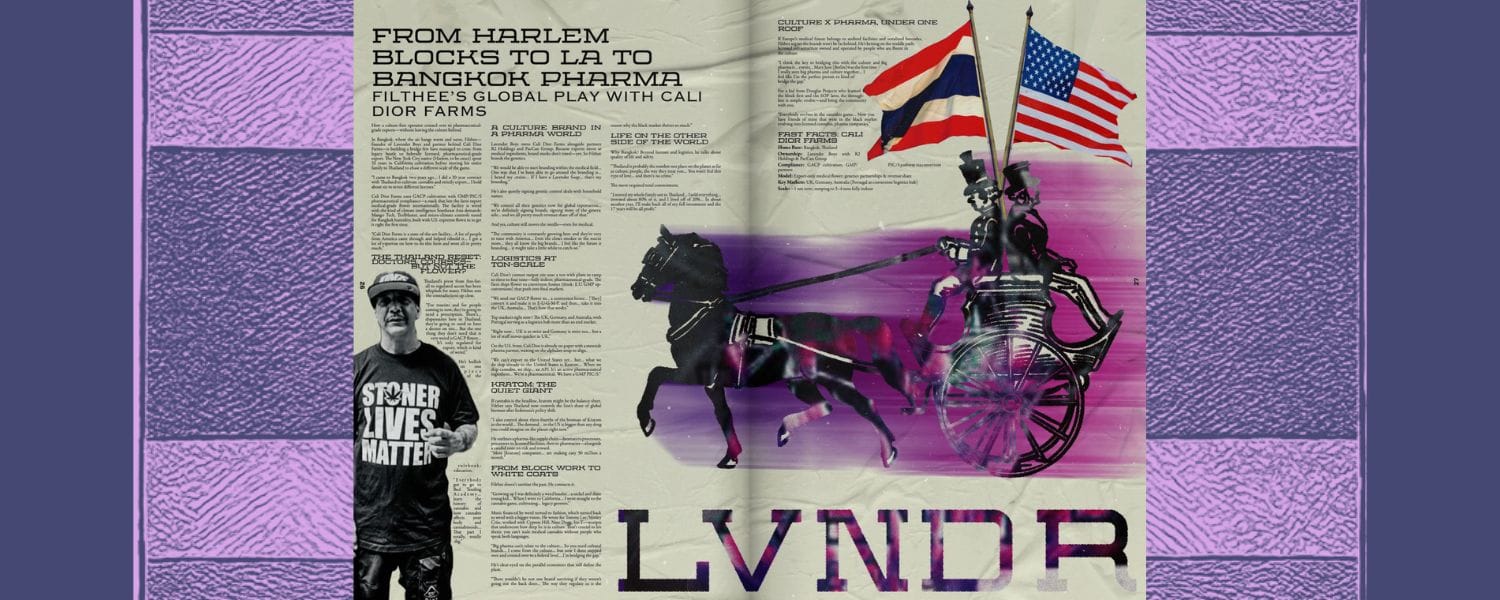

How a culture-first operator crossed over to pharmaceutical-grade exports—without leaving the culture behind.
In Bangkok, where the air hangs warm and neon, Filthee—founder of Lavender Boys and partner behind Cali Dior Farms—is building a bridge few have managed to cross: from legacy hustle to federally licensed, pharmaceutical-grade export. The New York City native (Harlem, to be exact) spent 32 years in California cultivation before moving his entire family to Thailand to chase a different scale of the game.
“I came to Bangkok two years ago… I did a 20 year contract with Thailand to cultivate cannabis and strictly export… I hold about six to seven different licenses.”
Cali Dior Farms runs GACP cultivation with GMP/PIC/S pharmaceutical compliance—a stack that lets the farm export medical-grade flower internationally. The facility is wired with the kind of climate intelligence Southeast Asia demands: Mango Tech, TrolMaster, and micro-climate controls tuned for Bangkok humidity, built with U.S. expertise flown in to get it right the first time.
“Cali Dior Farms is a state-of-the-art facility… A lot of people from America came through and helped rebuild it… I got a lot of expertise on how to do this farm and went all in pretty much.”
The Thailand Reset: Doctors, Courses—But Not the Flower?
Thailand’s pivot from free-for-all to regulated access has been whiplash for many. Filthee sees the contradictions up close.
“For tourists and for people coming in now, they’re going to need a prescription. There’s… dispensaries here in Thailand, they’re going to need to have a doctor on site… But the one thing they don’t need that is very weird is GACP flower… It’s only regulated for export, which is kind of weird.”
He’s bullish on one piece of the rulebook: education.
“Everybody got to go to Bud Tending Academy… learn the history of cannabis and how cannabis affects your body and cannabinoids… That part I totally, totally dig.”
A Culture Brand in a Pharma World
Lavender Boys owns Cali Dior Farms alongside partners R2 Holdings and PacCan Group. Because exports move as medical ingredients, brand marks don’t travel—yet. So Filthee brands the genetics.
“We would be able to start branding within the medical field… One way that I’ve been able to go around the branding is… I brand my strains… If I have a Lavender Soap… that’s my branding.”
He’s also quietly signing genetic control deals with household names.
“We control all their genetics now for global exportation… we’re definitely signing brands, signing more of the genetic side… and we all pretty much revenue share off of that.”
And yes, culture still moves the needle—even for medical.
“The community is constantly growing here and they’re very in tune with America… Even the closet smoker or the soccer mom… they all know the big brands… I feel like the future is branding… it might take a little while to catch on.”
Logistics at Ton-Scale
Cali Dior’s current output sits near a ton with plans to ramp to three to four tons—fully indoor, pharmaceutical-grade. The farm ships flower to conversion houses (think: E.U. GMP up-conversions) that push into final markets.
“We send our GACP flower to… a conversion house… [They] convert it and make it to E-U-G-M-P, and then… take it into the UK, Australia… That’s how that works.”
Top markets right now? The UK, Germany, and Australia, with Portugal serving as a logistics hub more than an end market.
“Right now… UK is so strict and Germany is strict too… but a lot of stuff moves quicker in UK.”
On the U.S. front, Cali Dior is already on-paper with a stateside pharma partner, waiting on the alphabet soup to align.
“We can’t export to the United States yet… but… what we do ship already to the United States is Kratom… When we ship cannabis, we ship… an API. It’s an active pharmaceutical ingredient… We’re a pharmaceutical. We have a GMP PIC/S.”
Kratom: The Quiet Giant
If cannabis is the headline, kratom might be the balance sheet. Filthee says Thailand now controls the lion’s share of global biomass after Indonesia’s policy shift.
“I also control about three-fourths of the biomass of Kratom in the world… The demand… in the US is bigger than any drug you could imagine on the planet right now.”
He outlines a pharma-like supply chain—biomass to processors, processors to licensed facilities, then to pharmacies—alongside a candid note on risk and reward.
“Most [kratom] companies… are making easy 50 million a month.”
From Block Work to White Coats
Filthee doesn’t sanitize the past. He connects it.
“Growing up I was definitely a weed hustler… a nickel and dime young kid… When I went to California… I went straight to the cannabis game, cultivating… legacy growers.”
Music financed by weed turned to fashion, which turned back to weed with a bigger vision. He wrote for Tommy Lee/Mötley Crüe, worked with Cypress Hill, Nate Dogg, Ice-T—receipts that underscore how deep he is in culture. That’s crucial to his thesis: you can’t scale medical cannabis without people who speak both languages.
“Big pharma can’t relate to the culture… So you need cultural brands… I come from the culture… but now I done stepped over and crossed over to a federal level… I’m bridging the gap.”
He’s clear-eyed on the parallel economies that still define the plant.
“There wouldn’t be not one brand surviving if they weren’t going out the back door… The way they regulate us is the reason why the black market thrives so much.”
Life on the Other Side of the World
Why Bangkok? Beyond licenses and logistics, he talks about quality of life and safety.
“Thailand is probably the number one place on the planet as far as culture, people, the way they treat you… You won’t feel this type of love… and there’s no crime.”
The move required total commitment.
“I moved my whole family out to Thailand… I sold everything… invested about 80% of it, and I lived off of 20%… In about another year, I’ll make back all of my full investment and the 17 years will be all profit.”
Culture x Pharma, Under One Roof
If Europe’s medical future belongs to audited facilities and serialized barcodes, Filthee argues the brands won’t be far behind. He’s betting on the middle path: licensed infrastructure owned and operated by people who are fluent in the culture.
“I think the key to bridging this with the culture and big pharma is… events… Mary Jane [Berlin] was the first time I really seen big pharma and culture together… I feel like I’m the perfect person to kind of bridge the gap.”
For a kid from Douglas Projects who learned the block first and the SOP later, the through-line is simple: evolve—and bring the community with you.
“Everybody evolves in the cannabis game… Now you have friends of mine that were in the black market evolving into licensed cannabis, pharma companies.”
Fast Facts: Cali Dior Farms
- Home Base: Bangkok, Thailand
- Ownership: Lavender Boys with R2 Holdings & PacCan Group
- Compliance: GACP cultivation; GMP/PIC/S pathway via conversion partners
- Model: Export-only medical flower; genetics partnerships & revenue share
- Key Markets: UK, Germany, Australia (Portugal as conversion/logistics hub)
- Scale: ~1 ton now; ramping to 3–4 tons fully indoor
For more visit https://calidiorfarms.com and Instagram
