
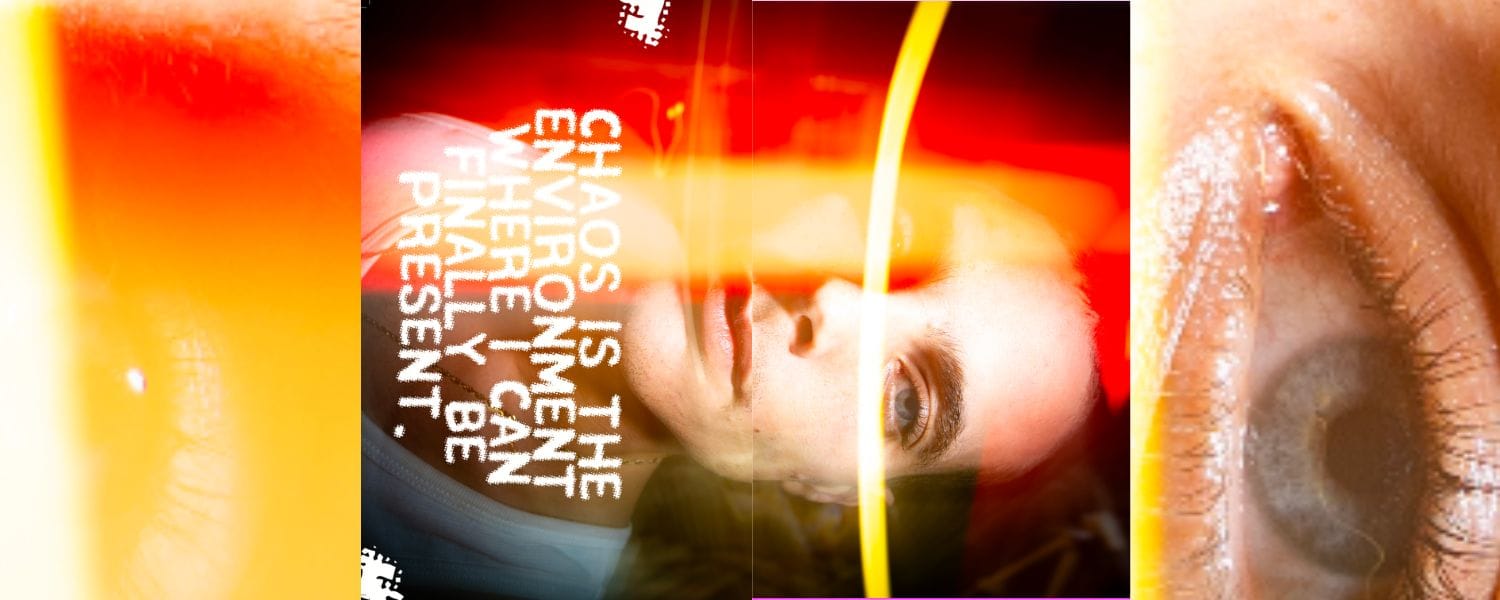
Tel Aviv has a way of collapsing opposites into the same street corner. Holy and profane. Tender and electric. A city that can feel like a hug one minute and a siren the next. It’s the perfect backdrop to meet Dudu Faruk—an artist whose whole thing is contrast without compartmentalizing it.
Seance by Dudu Faruk produced by Honeysuckle Media
We’re in his space, where the day moves like a music video in pre-production: people shifting gear, talk of B-roll, camera notes, the casual comedy of a cat who keeps stealing the scene. Dudu’s energy is both restless and grounded—like someone living in multiple tempos at once, but somehow still in rhythm. In conversation, he keeps returning to one idea: the separation between “life” and “art” isn’t real for him. It’s all one continuum.
“I’m an artist, musician and actor. And I just love art. It’s like my way of being… It’s all I do,” he says. “Really, my day is art. My schedule is art for me. It’s everything. It’s like a religion for me.”
That word—religion—matters here, not as branding, but as a worldview. For Dudu, whose signature is integrating blunt and sometimes over-the-top trap with more traditional Mizrahi music, art isn’t an output. It’s a survival system. A way to access reality without getting swallowed by it.
A kid with a piano, a mind built for patterns
Known for viral videos that showcase his outrageous character, Dudu Faruk is something of a cultural signal. His YouTube channel has amassed approximately 70 million views and growing. He’s been called “the biggest star in Israeli hip-hop” and “the sexiest man in Israel,” is noted as a gifted comedian, and is currently the face of leading fashion brand Urbanica, alongside the singer Frida.
Yet Dudu’s story begins before his outsize persona became his hallmark. Like a lot of artists who seem “born different,” his earliest memories aren’t about choosing art—it’s about doing it, instinctively, because it was the most natural language available.
“I started piano, when I was like nine,” he says. “I always had characters and I was performing in many forms, not just music.”
His family appreciated art, but didn’t exactly picture it as the plan. “They wanted me to go to the university and to study math or physics or be a doctor or something,” he says. He did take the academic route seriously at first—physics and math in high school—because he has the kind of brain that wants structure as much as it wants freedom.
“I’m very analytic,” he explains. That duality of logic and impulse, calculation and chaos, shows up everywhere in the way he talks about sound, performance, and the way he moves through a room.
The musician learned instruments in a patchwork, street-level way: some formal instruction, some obsessive self-teaching, a lot of disappearing into his own process. “I started with guitar… and piano… But all the other instruments, I had the first knowing of how to reach to an instrument, and then I just spread it for every instrument, drums, and basic guitar, and Darbuka. I love Darbuka… and Tabla [traditional drums common in North African and Indian music respectively].”
Even that list is its own statement: Western training braided with ancient percussion, a sonic passport that doesn’t ask permission.
Passion over strategy
Watching Dudu, you get the sense that he’s constantly reading the room—not as manipulation, but as a kind of sensitivity that can’t be turned off. One moment he’s intense and aggressive, the next he’s soft, playful, reflective. It’s a range that looks like intention from the outside.
He rejects that idea immediately.
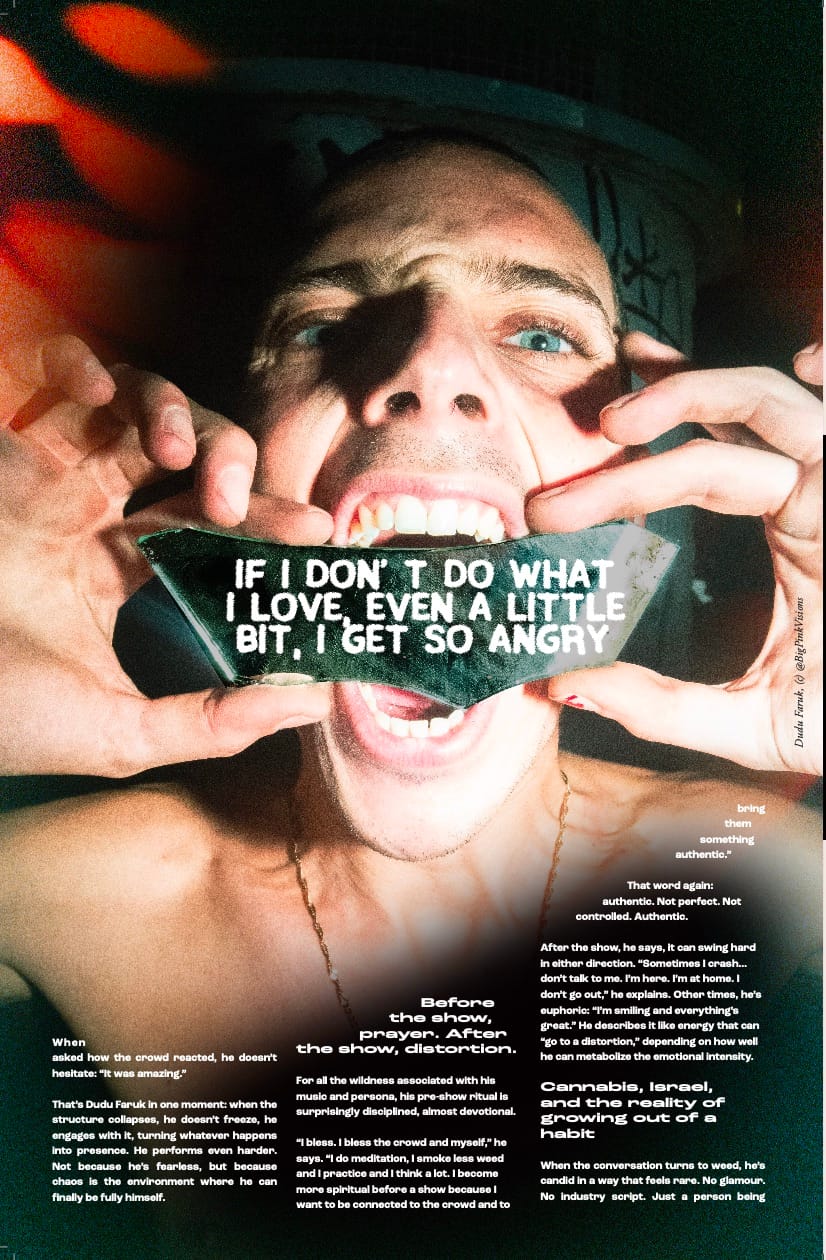
“No, it’s just passion. Only passion,” he says. “Life can be painful. This is the place to just do whatever you want. Just have fun. You do what you love. And if I don’t do what I love, even a little bit, I get so angry.”
In other words: he’s not toggling personas for effect; he’s trying to stay emotionally regulated inside an environment that can be overwhelming. In Tel Aviv, that kind of sensitivity can feel like a liability. For him, it becomes the raw material.
Israel, he says, is intense in a way that gets into your nervous system. “In Israel, it’s a very energetic and emotionally charged place… It’s [a] very intense country, I guess.”
That refusal—of easy explanation, of packaged suffering—is part of his integrity. He doesn’t want to sell pain. He wants to transmute it.
The Dudu Faruk persona: permission to live
The Dudu Faruk character isn’t a mask in the usual sense. It’s more like a switch that changes his relationship to reality, stepping into a frequency where chaos doesn’t drown him, it fuels him.
“Everything gets better when I’m being Dudu,” he says. “I can say whatever I want. I can feel myself and go and crazy shit can happen outside and I will be like, ‘Nice.’ The chaos around me becomes energy. It’s wild and it makes me feel fully alive..”
That line lands heavily because it’s not a metaphor. He describes being so sensitive in daily life that even small contact can trigger him: “On [a] daily basis, even my cat can touch me and I’m like, ‘Woo, I feel so much.’” But inside the character? “When I’m in the character, I don’t feel nothing. I feel alive. I feel power.”
This is the overlooked truth of performance for certain artists: the stage isn’t where they pretend. It’s where they finally become functional.
Acting as therapy, and the moment the show broke open
Music is his playground—his rules, his chaos, his control. Acting is different because it’s collaborative, structured, built around other people’s choices. “Yes, because it’s not my playground because there’s a director and there [are] people to work with and schedule, so it’s different,” he says. But then he adds the part that reveals why he loves it: “It’s fun. There’s healing that comes with the fun every time. It’s a therapy for me.”
He describes acting as a mystery, something you can’t fully predict or intellectualize. “The sense of mystery is essential,” he states. “You don’t know where you’re going - and I don’t mean that as lacking direction. Even when you’re fully prepared and understand the script and the structure, the moment the director says, ‘Action,’ it feels like you’re pressing a button into the unknown.”
Then he tells a story that feels like a blueprint for his whole artistic identity: a massive show, 8,000 people, where the music suddenly stops. For most performers, that’s a nightmare. For him, it turned into a portal.
“I got into a character,” he says. “I realized that now the show is happening now when the problem’s happening, on the chaos and there is no music… Now that’s my place to perform.”
When asked how the crowd reacted, he doesn’t hesitate: “It was amazing.”
That’s Dudu Faruk in one moment: when the structure collapses, he doesn’t freeze, he engages with it, turning whatever happens into presence. He performs even harder. Not because he’s fearless, but because chaos is the environment where he can finally be fully himself.
Before the show, prayer. After the show, distortion.
For all the wildness associated with his music and persona, his pre-show ritual is surprisingly disciplined, almost devotional.
“I bless. I bless the crowd and myself,” he says. “I do meditation, I smoke less weed and I practice and I think a lot. I become more spiritual before a show because I want to be connected to the crowd and to bring them something authentic.”
That word again: authentic. Not perfect. Not controlled. Authentic.
After the show, he says, it can swing hard in either direction. “Sometimes I crash… don’t talk to me. I’m here. I’m at home. I don’t go out,” he explains. Other times, he’s euphoric: “I’m smiling and everything’s great.” He describes it like energy that can “go to a distortion,” depending on how well he can metabolize the emotional intensity.
Cannabis, Israel, and the reality of growing out of a habit
When the conversation turns to weed, he’s candid in a way that feels rare. No glamour. No industry script. Just a person being honest about a relationship that changed.
“For me, [weed] is about balance,” he shares. “In moderation, it’s beautiful, freeing, and creatively inspiring.” But he’s upfront about his sensitivity to overusing the plant, and that while it helps when he’s in the sweet spot of “just right,” smoking more than necessary isn’t always helpful to his process. “If I don’t smoke, I create more. That’s the reality right now.”
He’s not moralizing it. He’s observing himself. That’s the whole interview, really—an artist studying his own patterns in real time.
On legality, he puts it plainly: “It’s illegal to buy if you don’t have a medical license, but everyone can buy everywhere in Israel. It’s very easy to get.” Socially, he says Tel Aviv is its own world: “Tel Aviv more than other cities. Almost everywhere.”
Judaism, ancestry, and a private spirituality
Dudu’s spirituality isn’t performative either. It’s intimate, self-driven—something he found in the absence of it at home.
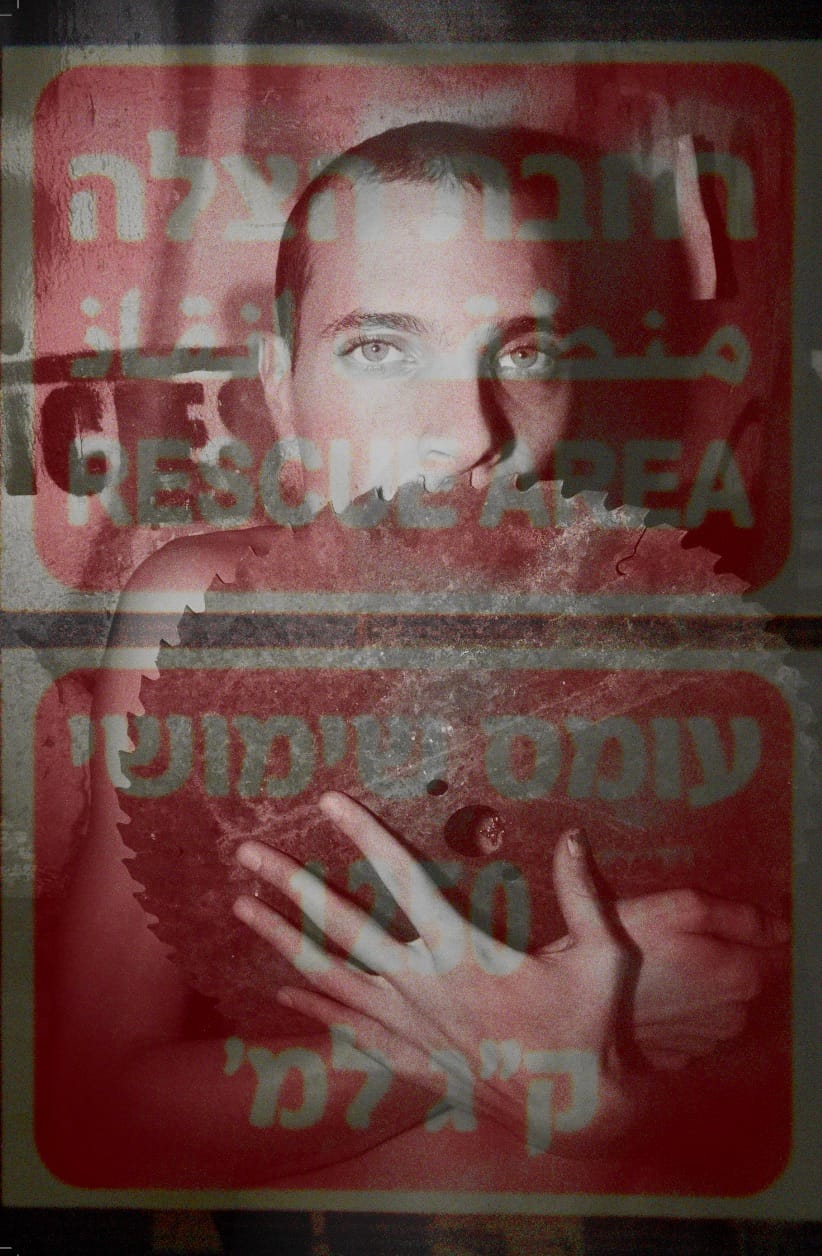
“I love Judaism and I love the Kabbalah and the leathers [tefillin, Torah verses that are bound to the arm with leather straps during prayers],” he says, moving between reverence and casual phrasing the way Israelis often do: sacred as part of daily language.
His background is layered: “Moroccan. Half Moroccan… half Moroccan and quarter Egyptian… Ashkenazi… Lithuania.” He mentions a “grand-grandfather” who was “a huge rabbi,” well-known, even though his immediate family isn’t religious or spiritual.
“So how did you learn and become that way?” we asked him.
“I don’t know,” he says. “I think the lack of God in the house made me try to confront it a little bit.” Then he describes a childhood memory that feels like a clue: “When I was five years old, I remember myself closing my eyes and imagining I’m in a bird body and doing Zen things.”
That’s Dudu again—spirit without institution. Sensitivity without doctrine. A seeker who refuses easy labels.
What’s next: expansion, but on his terms
If there’s one thing he keeps circling back to, it’s growth that doesn’t feel like chasing. He wants international reach, not as a trophy, but as a natural widening of the light he’s already putting out.
“I would love to spread internationally,” he says. “I feel like I just do light. It’s light more, more humans, human beings.”
He talks about building new forms: DJing now, expanding the live experience, keeping it moving. When asked about projects, he’s guarded—not from ego, but from superstition. “Some of my projects, I don’t talk about them for me,” he says. “So you will have to be surprised.”
Still, he offers a glimpse into a new TV project: a character “between”—not fully religious, not fully secular—living in that complicated Israeli middle space where identity is never simple. “You need to know both of the worlds to be there,” he explains. The series is expected “in a month,” and he’s one of four main characters.
There’s also a documentary about Jerusalem that he’s in the process of filming, and he mentions the scale of his upcoming performances: “Big shows? I have like five or six… There’s 20 scheduled already, but there will be more.”
And yes, there’s merch—a tangible extension of the universe—slid across like a small blessing, a piece of the Dudu frequency you can wear. That would be his clothing line Arak, a Mediterranean-inspired brand which draws its name from his hit song “Arak Arak Arak.” The brand will soon be releasing for the public after a long time in development with the same quality, care, and authenticity which Dudu dedicates to all his art.
The cover story truth: Dudu Faruk is a system, not a character
It’s easy to talk about Dudu Faruk like he’s only a persona—an outrageous alter ego built for the algorithm. But sitting with him in Tel Aviv, you realize the character is actually a tool: a technology for living. A way to move through intensity without collapsing. A way to turn overstimulation into art.
Dudu doesn’t present himself as an icon who has it figured out. He presents himself as someone constantly recalibrating—between sensitivity and power, spirituality and absurdity, discipline and chaos. The result is an artist who doesn’t just perform for a crowd. He connects to them like a circuit—charging, burning, healing, crashing, returning.
And in a city that runs on contrast, that kind of honesty is its own headline.
