
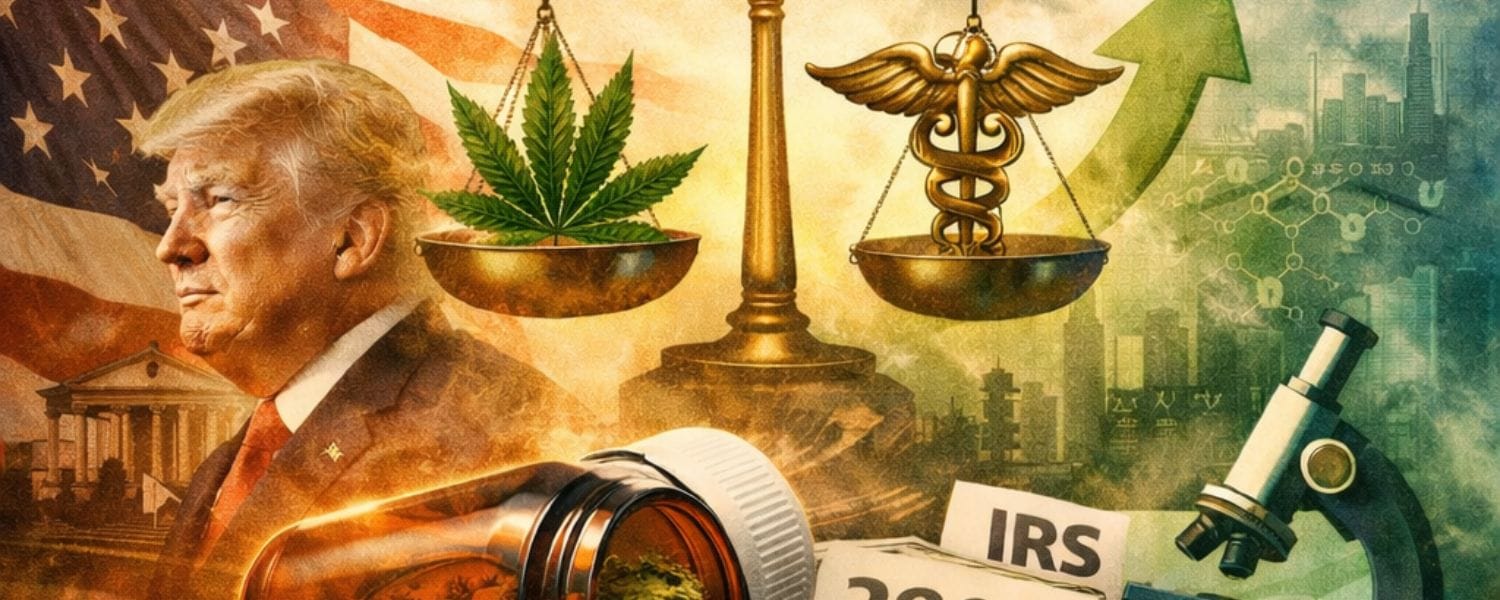

Industry leaders respond to President Trump’s executive order reclassifying cannabis as a Schedule III substance
The federal government’s decision to reclassify cannabis from Schedule I to Schedule III marks the most significant shift in U.S. cannabis policy to date. While the move stops short of full legalization, it signals a fundamental change in how cannabis is treated under federal law—opening doors for expanded research, potential tax relief, and broader financial participation, while also raising new questions about implementation, equity, and oversight.
For operators across the regulated cannabis ecosystem, rescheduling represents both validation and a turning point.
“Cannabis rescheduling is a meaningful step toward aligning federal policy with where consumers and the broader health and wellness market already are,” said Matt Melander, President of Sun Theory, parent company to Dialed In Gummies, 13 cannabis retail locations, Arnie’s Topicals, and other wellness-focused brands. “While rescheduling alone won’t solve every challenge facing the industry, it represents real progress toward a federal framework that allows research, regulation, and legitimate businesses to operate more effectively.”
Moving cannabis to Schedule III removes a classification that long treated regulated cannabis as an illicit substance with no accepted medical value. According to Melander, the shift away from Schedule I is critical not only symbolically, but operationally.
“Reclassifying cannabis from Schedule I to Schedule III removes long-standing barriers to legitimate medical research and signals increasing regulatory maturity at the federal level,” he said.
From a business standpoint, many industry leaders point to the potential downstream effects of rescheduling—particularly the anticipated removal of IRS Code 280E, which has prevented cannabis businesses from deducting standard operating expenses.
“For Sun Theory and other well-run businesses, the eventual removal of 280E would allow capital to flow back into people, infrastructure, and innovation rather than an outdated tax regime,” Melander said. “That shift accelerates the industry’s transition into a more mature phase defined by real earnings power and long-term sustainability. We also hope rescheduling opens the door to meaningful banking reform, allowing commercial banks and institutional capital to participate responsibly.”
Technology leaders echo that view, emphasizing the broader implications beyond balance sheets.
“The rescheduling of cannabis is monumental in terms of access to capital and tax relief,” said David Sandelman, Chief Technology Officer and Co-founder of Cannatrol. “But it will also be remembered as a defining moment when a real shift in attitudes toward cannabis became possible.”
Sandelman believes rescheduling will accelerate research and consumer confidence while reflecting how far the industry has come.
“No longer in its infancy, the cannabis industry is developing technologies that refine production, processing, and the true promise of the plant,” he said. “The industry is more professionally run than ever, and rescheduling may remove one of the last roadblocks to broader acceptance and stigma reduction.”
Operators across product categories agree that rescheduling helps level a playing field long skewed by tax and banking inequities.
“This finally places cannabis closer to where it should be,” said Corey Keller, co-owner and co-founder of Bonanza Cannabis Company. “It should reduce the industry’s tax burden while expanding financial opportunities for cannabis businesses to invest in new markets, grow their teams, and continue building what has already become a world-changing industry.”
Craft-focused operators see similar upside. Jimmy Brinkerhoff, CEO and co-founder of Edun, noted that financial relief could meaningfully improve industry economics while encouraging new consumers to explore regulated cannabis.
“The sheer tax implications if 280E is no longer applicable will remove a massive financial burden,” Brinkerhoff said. “If financial institutions begin to loosen resistance, the coming year could dramatically improve bottom lines. We’re cautiously optimistic this also continues to reduce stigma and bring new consumers into the market.”
From a brand perspective, rescheduling reinforces how consumers already approach cannabis.
“From a brand standpoint, this reflects how consumers already view the plant—as something that can be approached thoughtfully, responsibly, and with intention,” said Max Vansluys, President of Dialed InGummies. “Moving cannabis toward Schedule III helps remove barriers to research and allows brands to participate more fully in education, innovation, and transparency.”
Vansluys emphasized that rescheduling creates space for craft brands to stand out through quality and consistency.
“Dialed In has always been built around solventless rosin, clean inputs, and small-batch collaboration with top cultivators,” he said. “As policy evolves, consumers gain more confidence in what they’re putting into their bodies and how it makes them feel.”
Still, not all industry voices view rescheduling as sufficient on its own.
“My initial reaction is: be careful what you wish for,” said Corey Coleman, founder of Sky High Brands and the Iowa Hemp Coalition. “Schedule III still leaves state-licensed operators federally illegal. It over-regulates cannabis while keeping it illegitimate, which can strangle growth.”
Coleman called for comprehensive legislation governing both cannabis and hemp, rather than incremental fixes.
Similarly, Rebecca Maestas Sincere, Founder of Maestro Advising, warned that rescheduling must be paired with fair enforcement.
“Regulated operators have paid to play—licensing, compliance, testing—while being punished by 280E,” she said. “Rescheduling is progress, but it becomes unworkable if intoxicating hemp remains effectively unregulated. Fair taxes and workable banking should reward the regulated market, not undercut it.”
Other leaders focused on how rescheduling reshapes competition itself.
“Today’s announcement reshuffles competitive dynamics,” said Daniel Cook, CEO of True Terpenes. “Brands that have invested in repeatability, data, and real sensory fidelity will lead forward. That foundation positions our partners to outperform in a rescheduled landscape.”
From the genetics and cultivation side, Sergio Martinez, Founder & CEO of Blimburn Seeds, described the move as encouraging—but incomplete.
“This is an important signal that policy is beginning to align with science and patient needs,” Martinez said. “But it doesn’t undo the harm caused by restrictions on hemp genetics. Real progress requires consistent policy that protects innovation, agriculture, and access across the entire ecosystem.”
For consumer-facing categories, rescheduling also raises expectations around responsibility and clarity.
“Rescheduling raises the bar for responsibility,” said Mary Bernuth, Co-founder and President of Pharos Brands. “As more older adults explore cannabis beverages, transparency around regulation, dosage, and intent becomes critical. This creates an opportunity for a more disciplined, trustworthy marketplace.”
Ultimately, many see rescheduling as a foundation—not a finish line.
“Directing cannabis to Schedule III acknowledges accepted medical use and begins removing structural barriers,” said Jamie Pearson, CEO of New Holland Group. “But rescheduling is not legalization. The real work now lies in thoughtful implementation, ensuring research, access, and public safety advance together.”
Taken together, the industry’s response reflects cautious optimism, realism, and momentum. Cannabis rescheduling may not resolve every challenge—but it marks the clearest federal acknowledgment yet that the industry has outgrown its past, and that its next chapter will be shaped by research, accountability, and long-term discipline.
