
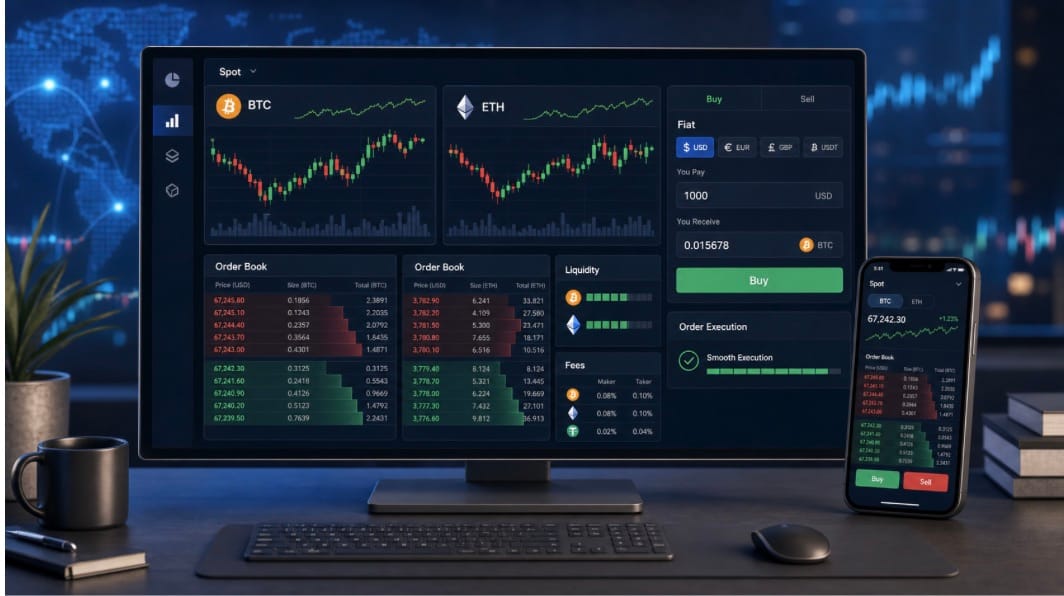
Spot trading platforms are no longer competing on token count alone. At the retail tier, major exchanges are undercutting each other in ways that would've seemed unlikely even eighteen months ago—a trend you can track by browsing fee schedules on aggregators like CoinGecko. But the race isn't just about cheaper trades.
Exchanges are now competing on fee transparency, how smoothly they can guide someone from account setup to a first BTC or ETH purchase, and whether they offer built-in tools that make accumulation strategies less manual. For anyone shopping for a spot trading platform to buy Bitcoin or Ethereum in 2026, those practical factors matter far more than how many obscure pairs a platform lists.
For spot traders, a good platform is not only about having more coins or lower fees. The real test is whether it offers enough liquidity, stable order execution, clear trading costs, smooth fiat access, and tools that help users manage BTC and ETH purchases without unnecessary friction.
Here's what we'll cover: each of those trends, where they're headed, and how platforms like BYDFi, Binance, Kraken, and KuCoin are staking out different positions as the market matures.
What Makes a Spot Platform Useful for BTC and ETH Buyers
A useful spot platform is not only about listing more coins or advertising lower fees. For BTC and ETH buyers, liquidity, order-book depth, and execution stability all affect the final trading experience. Thin order-book depth can lead to wider spreads and more slippage when users place larger spot orders, while an unstable interface may cause missed prices during volatile market moves.
This is why a spot trading platforms comparison should look beyond token count. A strong platform should help users buy and sell major assets smoothly, keep order updates reliable, and make the trading process clear enough for both first-time buyers and regular accumulators.
The Real Cost of Buying Bitcoin and Ethereum
Trading cost is not only about the maker and taker fee shown on the fee page. Spot traders should also consider spreads, slippage, fiat provider charges, and withdrawal costs. A platform with a clear fee model can make cost planning easier, especially for users who buy BTC or ETH regularly through dollar-cost averaging.
For example, a flat 0.1% maker and 0.1% taker spot fee is easier for many retail buyers to understand than a tiered structure that depends on monthly volume, exchange tokens, or VIP levels. High-volume traders may still prefer tiered models, but regular buyers often value predictability.
Fiat Access and Onboarding Still Shape the First Trade
For many first-time buyers, the trading experience starts before they ever open a chart. A strong spot platform should make it easy to buy BTC or ETH through cards, bank transfers, local payment methods, or third-party payment providers. Fiat access matters because even low trading fees mean less if users cannot fund their account conveniently in their local currency.
Onboarding also needs to balance convenience with compliance. Some platforms allow users to create an account quickly, while additional verification may be required for fiat deposits, higher withdrawal limits, P2P access, or specific regional requirements. BYDFi also publishes Proof of Reserves information showing user assets backed at over 1:1, and users should still review each platform's reserve disclosures, custody model, and account protection terms before trading.
The broader trend here matters because global regulatory fragmentation means onboarding requirements look completely different depending on where you live. As CoinDesk reported in its analysis of global crypto onboarding barriers, verification remains one of the biggest friction points for first-time crypto buyers.
On the fiat side, third-party payment provider ecosystems supporting Banxa, Paybis, Transak, Mercuryo, and Coinify, along with Apple Pay, Google Pay, and Pix, are becoming more common. That breadth matters for an Ethereum buying guide aimed at a global audience—especially buyers in markets where card-based crypto purchases aren't straightforward.
How Automation Is Changing Spot Accumulation
Automation is another reason spot platforms are changing. Instead of relying only on manual timing, users can now use tools such as Spot Grid, Spot DCA, Spot Martingale, and Bot Marketplaces to build or adjust positions more systematically.
Spot Grid bots are designed for range-bound markets by placing buy and sell orders within a selected price range. Spot DCA bots take a different approach by making fixed purchases at regular intervals, which can help long-term BTC or ETH buyers reduce emotional timing decisions. These tools do not guarantee better returns, but they can make accumulation more structured for users who understand the risks and parameters.
The honest caveat: bots execute strategy, not judgment. A Spot Grid configured for a narrow price range will underperform a simple buy-and-hold if Bitcoin trends sharply upward beyond that range. Parameters matter more than the tool itself.
Quick Checklist Before Choosing a Spot Platform
Before choosing where to buy BTC or ETH, users can ask a few practical questions:
● Liquidity and depth: Can major pairs be traded with reasonable spreads and limited slippage?
● Execution experience: Are orders placed and updated smoothly during volatile market conditions?
● Trading cost: Are maker/taker fees, spreads, fiat provider fees, and withdrawal costs easy to understand?
● Fiat access: Can users buy crypto through cards, bank transfers, or local payment methods?
● Automation: Are tools such as Spot Grid, Spot DCA, or copy trading available for users who do not want to time every trade manually?
● Security: Does the platform publish reserve information and explain account protection clearly?
Positioning Your BTC and ETH Strategy for What Comes Next
Fee clarity, flexible onboarding, and accessible automation are converging to make spot crypto trading more strategic and less intimidating. Heading into late 2026, platforms that deliver on all three may be better positioned to attract retail users—though market dynamics and regulatory shifts could reshuffle competitive advantages quickly.
For newcomers, the most straightforward path is often the simplest: use a platform's fiat on-ramp to BYDFi buy crypto directly with a card or local payment method, then explore automation tools once you're comfortable with the basics. If you want to test strategies before risking real capital, demo accounts preloaded with virtual funds can help.Copy Trading features can add another option for users who want to study experienced traders’ strategies instead of configuring every parameter manually.
FAQ
What's the cheapest fee structure for spot trading Bitcoin in 2026?
It depends on your volume. Flat-fee models around 0.1% maker/taker can provide predictable costs at lower volumes, while tiered models may become cheaper for high-volume traders. Always compare total cost including deposit, spread, fiat provider, and withdrawal fees.Tiered models can be cheaper if you're trading large amounts consistently. Always compare total cost including deposit and withdrawal fees.
How do spot trading bots work for Bitcoin accumulation?
Spot DCA bots automate periodic fixed-amount purchases, building a BTC position systematically over time. Spot Grid bots buy low and sell high within a set price range. Both can help reduce emotional timing pressure, though neither guarantees improved returns over other strategies.
