
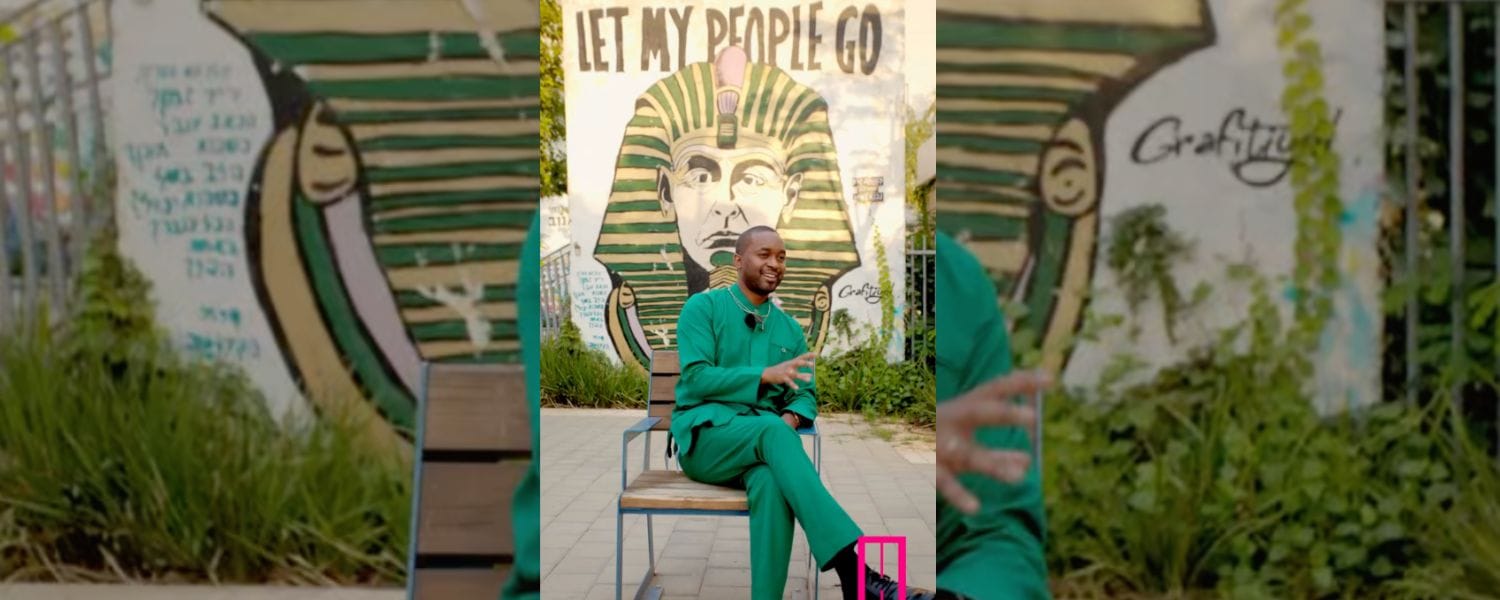

Ashriel Moore on the Ancient Roots of Hebrew Identity: A Conversation with the African Diaspora Collective Ambassador
For many people encountering the term Hebrew Israelites today, the assumption is that it represents a modern movement—something formed in the 1960s or shaped by recent cultural shifts. But according to Ashriel Moore, respected historian and African Diaspora Collective Ambassador, that belief couldn’t be further from the truth.
“When we say Hebrew Israelites, people imagine this is a new reality,” Moore explains. “They think it’s something that only started spreading in the late 20th century. They’re absolutely incorrect.”
Moore emphasizes that the identity, lineage, and spiritual framework associated with Hebrew Israelites is far older than most realize.
“It’s ancient,” he says. “Not only ancient, but a continuation of what we’ve practiced since the First Temple period.”
Why “Hebrew Israelite”? Clarifying Origins and Lineage
Moore breaks down a key distinction: the term Hebrew Israelite today is used not to create something new, but to clarify something very old.
“We refer to ourselves as Hebrew Israelites,” he notes, “because we want to be very clear who we’re talking about—how the seed of Israel continued, and through whom.”
This clarity matters historically, genealogically, and spiritually. The term ties present-day identity directly to the earliest foundational figures in biblical tradition.
Abraham: The First Hebrew
In explaining the lineage, Moore goes even deeper into the roots of the identity itself.
“People forget,” he says, “Abraham was a Hebrew. He wasn’t a Jew. He wasn’t a Judean. He wasn’t even an Israelite—because those are his descendants. They came after him.”
Abraham is described as Hebrew because of a specific word: Ivri, meaning to cross over.
“He was called a Hebrew because he crossed over—physically, spiritually, conceptually,” Moore explains. “He accepted a new idea, a new covenant, a new way. That concept—crossing over—is what we call Hebrew Eli.”
From Abraham came the Israelites, and from the Israelites came the Judeans. But Abraham himself stands at the very beginning—the Hebrew—establishing a tradition that would echo across millennia.
A Continuation, Not a New Creation
For Moore, the most important point is continuity. The identity, teachings, and traditions associated with the Hebrew Israelites are not an invention of the modern era, nor a reinterpretation of recent history. They are part of a long cultural, spiritual, and ancestral inheritance.
“It’s not new,” he states. “It’s the continuation of what we’ve done since the First Temple.”
As an ambassador for the African Diaspora Collective, Moore sees education as essential to reconnecting communities with their shared histories. Understanding the origins of the Hebrew identity—and recognizing its ancient lineage—is central to that mission.
Reclaiming an Ancient Narrative
In a time when misinformation spreads quickly and historical narratives are often flattened, Moore’s perspective brings essential context.
By distinguishing between Hebrew, Israelite, and Judean; by grounding the identity in Abraham; and by demonstrating the lineage’s evolution across time, Moore reminds audiences that this tradition is not merely alive—it is deeply rooted.
For members of the African diaspora and beyond, his message is clear:
Heritage is not something rediscovered—it is something remembered.
For more, follow Ashriel Moore on Instagram.
