
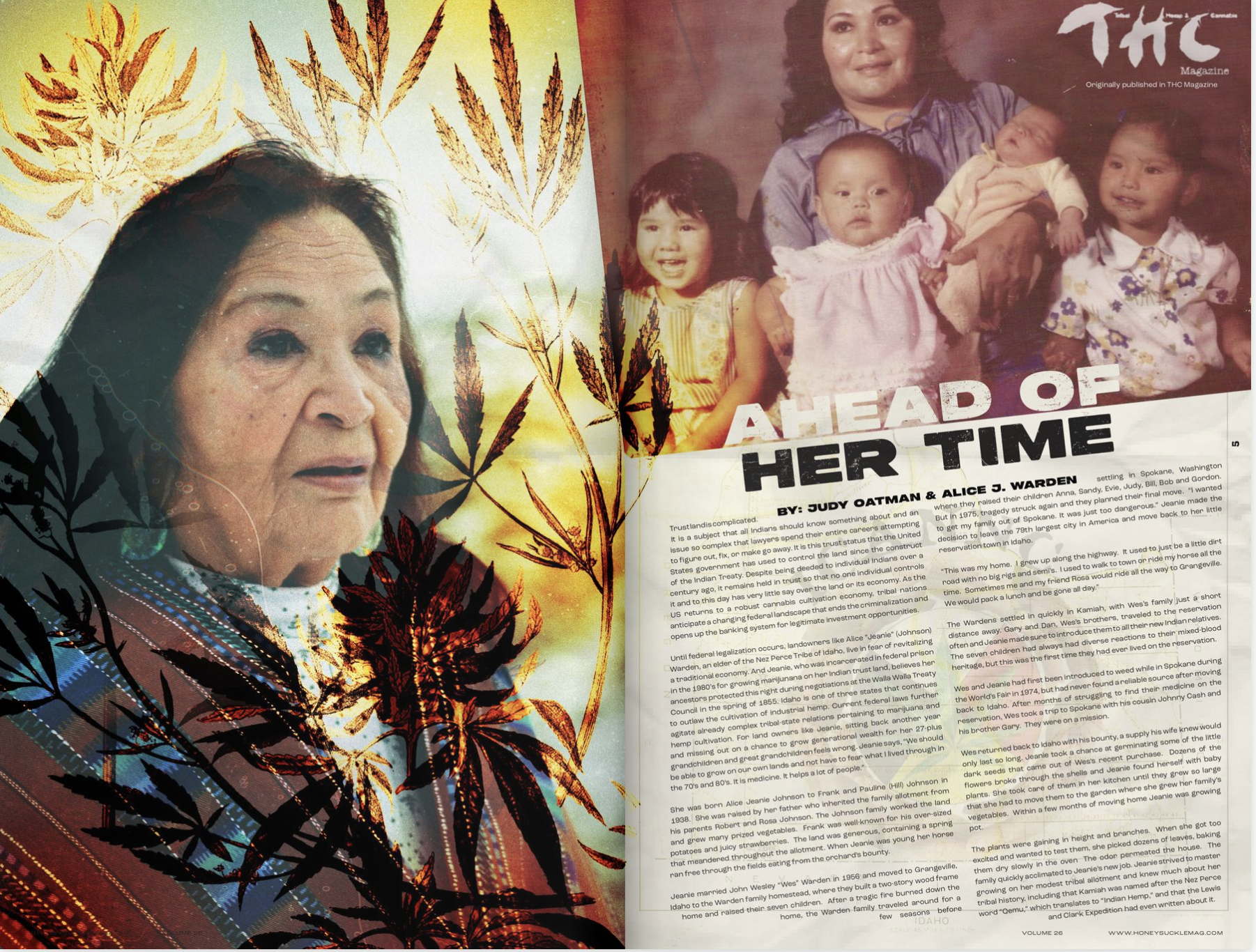
Ahead of Her Time
By Judy Oatman & Alice J. Warden
Originally published in THC Magazine
Trust land is complicated.
It is a subject that all Indians should know something about and an issue so complex that lawyers spend their entire careers attempting to figure out, fix, or make good away. It is this trust status that the United States government has used to control the land since the construct of the Indian Treaty. Despite being deeded to individual Indians over a century ago, it remains held in trust so that no one individual controls it and to this day has very little say over the land or its economy. As the US returns to a robust cannabis cultivation economy, tribal nations anticipate a changing federal landscape that ends the criminalization and opens up the banking system for legitimate investment opportunities.
Until federal legalization occurs, landowners like Alice “Jeanie” (Johnson) Warden, a traditional economy and elder of the Nez Perce Tribe of Idaho, live in fear of revitalizing “the 1980’s for growing marijuana on her Indian trust land.” Jeanie, who believes her ancestors protected this right during negotiations at the Walla Walla Treaty Council in the spring of 1855, lives in one of those states that continue to outlaw the cultivation of industrial hemp and cannabis. Current federal laws further agitate already complex tribal-state relations pertaining to marijuana and hemp cultivation. For land owners like Jeanie, sitting back and watching year after year of missed opportunity on a chance to grow generational wealth for her 27-plus grandchildren and great grandchildren feels wrong.
Jeanie says, “We should be able to grow on our own lands and not have to fear what I lived through in the ’70s and ’80s. It is medicine. It helps a lot of our people.”
She was born Alice Jeanie Johnson to Frank and Pauline (Hill) Johnson in 1938. She was raised by her father who inherited the family allotment from his parents Robert and Rosa Johnson. The Johnson family worked the land and grew many prized vegetables. Frank was well-known for his oversized potatoes and juicy strawberries. The land was generous, containing a spring that meandered throughout the allotment. When Jeanie was young her horse ran free through the fields eating from the orchard’s bounty.
Jeanie married John Wesley “Wes” Warden in 1956 and moved to Grangeville, Idaho to the Warden family homestead, where they built a two-story wood frame home and raised their seven children. After a tragic fire burned down the home, the Warden family traveled around for a few seasons before settling in Spokane, Washington when they raised their children Anna, Sandy, Evie, Judy, Bill, Bob and Gordon.
But in 1975, tragedy struck again and they planned their final move. “I wanted to get my family out of Spokane. It was just too dangerous,” Jeanie made the decision to leave the 79th largest city in America and move back to her little reservation town in Idaho.
“This was my home. I grew up along the highway. It used to just be a little dirt road with no big rigs and semis. I used to walk to town on ride my horse all the time. Sometimes me and my friend Rosa would ride all the way to Grangeville. We would pack a lunch and be gone all day.”
The Wardens settled in quickly in Kamiah, with Wes’s family just a short distance away. Gary and Dan, Wes’s brothers, traveled to the reservation often and Jeanie made sure to introduce them to their new Indian relatives. The seven children had always had diverse reactions to their mixed-blood heritage, but this was the first time they had ever lived on the reservation.
Wes and Jeanie had first been introduced to weed while in Spokane during the World’s Fair in 1974, but had never found a reliable source after moving back to Idaho. After months of struggling to find their medicine on the reservation, Wes took a trip to Spokane with his cousin Johnny Cash and his brother Gary. They were on a mission.
“We returned back to Idaho with his bounty. A supply his wife knew would only last so long. Jeanie took a chance at germinating some of the little dark seeds that came out of Wes’s recent purchase. Dozens of the flower broke through the shelf and Jeanie found herself with baby plants. She took care of them in her kitchen until they grew so large that she had to move them to the garden where she grew her family’s vegetables. Within a few months of moving home Jeanie was growing.”
The plants were gaining in height and branches when she got too excited and wanted to test them. She picked dozens of leaves, baking them dry slowly in the oven. The odor permeated the house. The family quickly acclimated to Jeanie’s new job. Jeanie strived to master growing on modest tribal allotment and knew much about her tribal history, including that Kamiah was named after the Nez Perce word “Qémes,” which translates to “Indian Hemp,” and that the Lewis and Clark Expedition had even written about it.
Fast forward to 1982. Nez Perce allotment #1356 was swarmed by federal and local police for the third time. From all directions. A SWAT-team-like scene from a movie going through the house and property searching for evidence of manufacturing and distribution. A warrant said “crimes in violation of Title 21, U.S.C. Section 841(a)(1) and Section 844, Possession of Marijuana.”
The first time was in 1978, when a Washington Water Power worker spotted Jeanie’s plants during routine meter reading. He contacted a local police officer who worked with the BIA to execute a search warrant. Plants were seized. After the last federal raid the couple was indicted in federal court for growing 112 plants.
It took over three years to prosecute Jeanie and Wes. Both federally charged and convicted. Even though Wes was not a tribal member or a land owner, he was also sentenced in the United States District Court. Jeanie served 6 months in federal prison, Wes a full year. For Jeanie this sentence was harder on her children than herself. She was resilient. And it wasn’t the first time she had been taken from her home and family.
When Jeanie was 5 years old she was sent to a boarding school in Desmet, Idaho. Her time spent at boarding school taught her many industrial skills, but she longed to be back in Kamiah with her dad and brothers. She did well in school until the fifth grade, when she ran away to the mountains. She was homesick.
That year she returned home to live with her dad and brother Ralph. Her father was a hardworking single father but was unable to care for her other little brother Frank Jr. He had a mental handicap and needed full-time care and assistance. Frank Sr. was unable to provide for him, so he left to care for his younger children alone. His wife Pauline just packed up and left her husband and three small children.
Jeanie’s mom Pauline Hill was Nez Perce and Delaware. She was the granddaughter of Tom Hill, an interpreter and scout that traveled west in the family wagon train and later joined forces with the Nez Perce. Written accounts of the Nez Perce War of 1877 show that Hill played a pivotal role in saving lives during the battle.
Pauline came from strong blood that had survived the war. Her parents learned and adjusted to a new way of living for Indian people. But the blood that she came from struggled to stay confined to the reservation system.
And so she left her kids to travel, eventually meeting up with George Finley, a 6’2” Colville Yakama that towered over her 4’11” frame. The couple loaded their station wagon with their dogs and blankets, cases of cheap whiskey, moonshine, and cartons of cigarettes to sell at pow-wow and stick game gatherings. They easily doubled the price of their merchandise, which they would purchase at the cheapest reservation stores or barter for along the way.
Every month Jeanie’s mother would visit her daughter in prison, traveling to the Geiger Correctional Center outside of Spokane, WA with her husband George. For Jeanie, these visits often felt like shame. Prison began making her feel like a convict. And with seven kids, Jeanie had not experienced solitude like this since she had ran away to the mountains.
So she had a lot of time to think.
“Do my kids think less of me?” “Is Wes going to hate me for sending him to prison?” And she also thought about what her community would say.
Jeanie had millions of thoughts about her life, where she was, where she was going, and where she should be.
When Jeanie arrived at the federal facility she shared a bunk with Jean Craig, a member of the Order, a white supremacist group. Craig was incarcerated for her role in the murder of Alan Berg, a prominent Jewish radio personality who was gunned down gangland-style in his driveway in 1984. Jeanie initially didn’t know if they would get along because Craig was a convicted Neo-Nazi. Yet she found that the woman nearly twenty years older than her reminded her of her mother-in-law Nellie Warden. Nellie was kind to Jeanie and became both mother and mentor.
Jean and Jeanie both hugged and cried during their last visit knowing they would never see each other again.
Jeanie was released and returned to Kamiah. She worked in the local mill as a stacker, pulling boards and preparing them for shipping. She stayed working there until the mill closed. She also spent several years in traffic control, standing up to twelve hours a day in extreme weather conditions. In the early 2000s, she decided to go back to school. Jeanie attended Lewis-Clark State College along with her two daughters, Sandy and Judy, and granddaughters Mary Jane and Terri Ann. They excelled in their academics.
But in the summer of 2004, Jeanie’s life changed again when Wes was diagnosed with colon cancer.
Wes was deteriorating quickly. Smoking and pain medication helped. Jeanie had decided to quit school because of her daily, one-hundred and sixty mile round trip commute. But Wes insisted that she continue with her education and their youngest daughter Diana served as his nurse. Having Diana there gave Jeanie peace of mind to continue with her college studies and graduate at the top of her class with a degree in Hotel/Hospitality Management.
We passed away on November 19, 2004, surrounded by his family who joined in one last circle sharing their sacred smoke. In prayer as Wes took his final breath.
Today, if Jeanie wants to purchase cannabis products legally she can do so just 20 minutes from the Nez Perce Reservation in Washington State. “The Gauntlet.” Fear and jury by local county, state and federal law enforcement jurisdictions that still consider cannabis a highly dangerous drug that continues to generate revenue for their respective municipalities. Jail. Bonds. Seizures. And eventually a large cash fine.
Reflecting on this industrious woman, this wife and mother, grandmother, great-grandmother, and great-great grandmother, one cannot deny that she was ahead of her time. Today she continues to flag on the highways, returning back to the industry after working for the state Ye Ye Tribal Casino. In February of 2019, Jeanie was pinned between two vehicles with only moments of life remaining in her body. She was able to reach the horn and honked until her daughter Diana could call 911. As she lay in the hospital, broken leg and ribs, she only one request. She asked her granddaughter, “Can you please call Richard and tell him I will be back to work as soon as I can?”
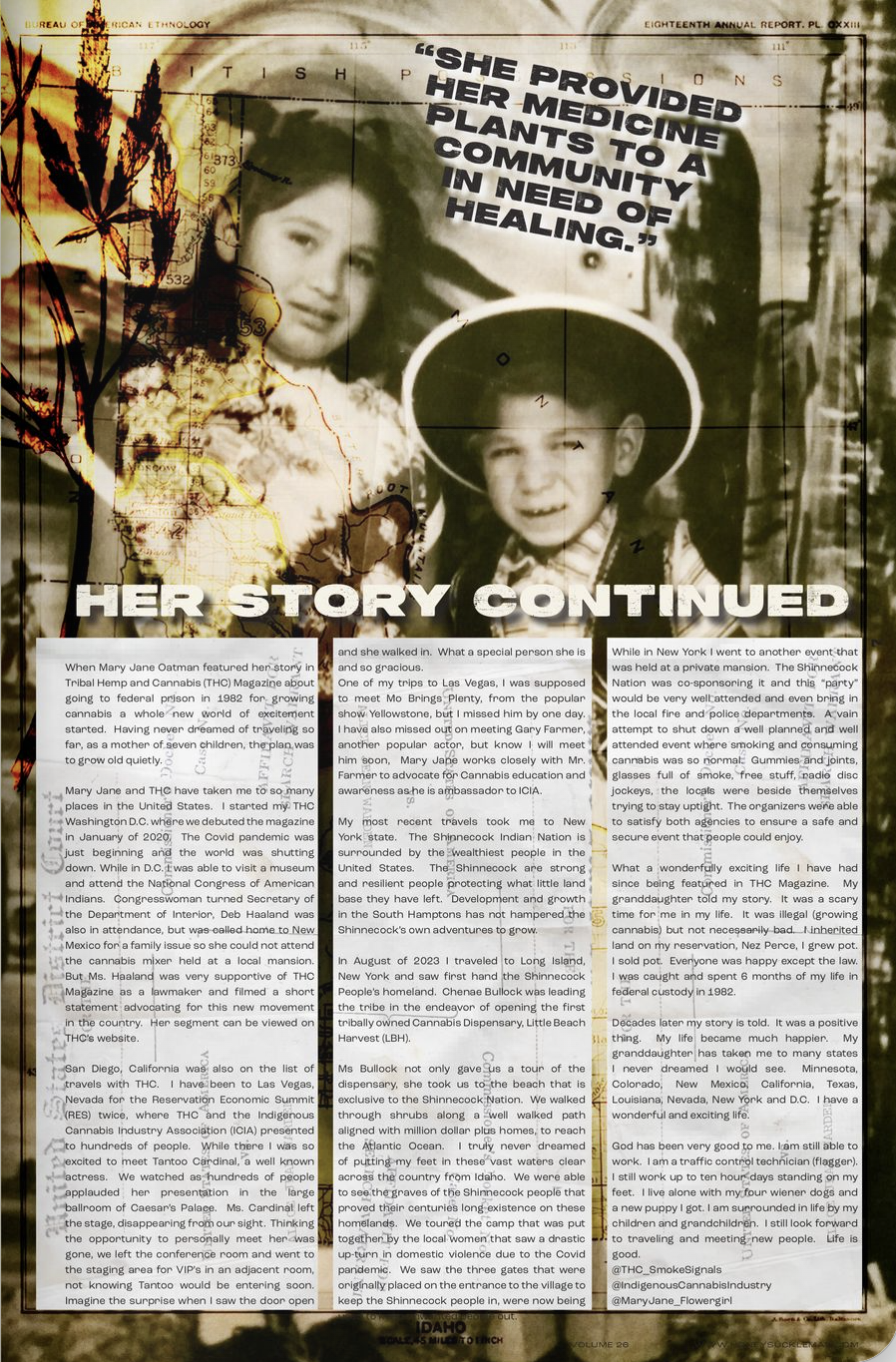
Alice “Jeanie” (Johnson) Warden is a legend who blazed trails. She provided her medicine plants to a community in need of healing. Today, it’s openly grown in many communities but remains illegal under federal, state, county and tribal law in Idaho. The Nez Perce people organized to legalize cannabis cultivation on their reservation in 2017 but the Tribal Executive Committee has yet to revise the tribal law and order code. On elders like Jeanie, who own large tracts of trust land on Indian reservations, where do they go from here to pursue a free market economy in the evolving world of cannabis?
Her Story Continued
When Mary Jane Oatman featured her story in Tribal Hemp and Cannabis (THC) Magazine about going to federal prison in 1982 for growing cannabis, a whole new world of excitement started. Having never dreamed of traveling so far, as a mother of seven children, the legacy was to grow old quietly.
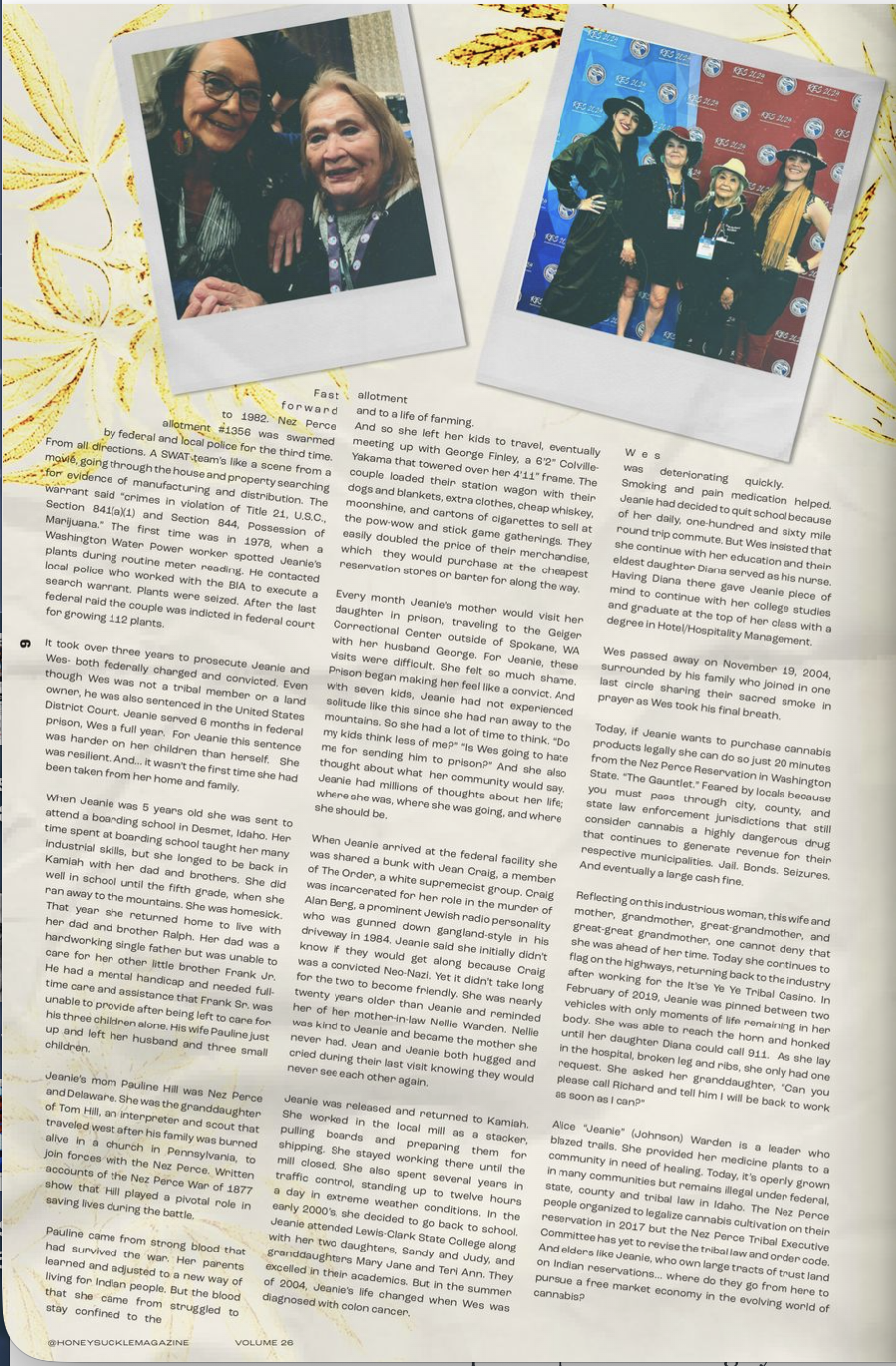
Mary Jane and THC have taken her to so many places in the United States. It started in Washington D.C., where we debuted the magazine in January of 2020. The Covid pandemic was just beginning and the world was shutting down. While in D.C. I was able to visit a museum and attend the National Congress of American Indians. Congressional Intern Secretary of the Department of Interior Deb Haaland was also in attendance, but was called home to New Mexico for a family issue so she could not attend the cannabis mixer held at a local mansion.
THC Magazine as a lawmaker and filmed a short statement advocating for this new movement in the country. Her segment can be viewed on THC’s website.
San Diego, California was also on the list of travels with THC. I have been to Las Vegas, Nevada for the Reservation Economic Summit (RES) twice, where THC and the Indigenous Cannabis Industry Association (ICIA) presented to hundreds of people. While there I was so excited to meet Tana Goertz, a well known actress. We watched as hundreds of people applauded her presentation in the large ballroom of Caesar’s Palace.
Ms. Goertz left the stage, disappearing from our sight. Thinking the opportunity to personally meet her was gone, we left the conference room and went to the staging area for VIP’s in an adjacent room, not knowing Tana would be entering soon. Imagine the surprise when I saw the door open and she walked in. What a special person she is and so gracious.
One of my trips to Las Vegas, I was supposed to meet Mr. Bo Briggs Plentyy, from the popular show Yellowstone, but I missed him by one day. I have also missed out on meeting Gary Farmer, another popular actor, but know I will meet him soon. Mary Jane works closely with Mr. Farmer to advocate for cannabis education and awareness as she is ambassador to ICIA.
My most recent travels took me to New York State. The Shinnecock Indian Nation is surrounded by the wealthiest people in the United States. The Shinnecock are strong and resilient people protecting what little land base they have left. Development and growth in the South Hamptons has not hampered the Shinnecock’s own adventures to grow.
In August of 2023 I traveled to Long Island, New York and saw firsthand how the Shinnecock People’s homeland. Chenae Bullock was leading the tribe in the endeavor of opening the first tribally owned Cannabis Dispensary, Little Beach Harvest (LBH).
Ms. Bullock not only gave us a tour of the dispensary, she took us to the beach that is exclusive to the Shinnecock Nation. We walked through shrubs along a well walked path aligned with million dollar plus homes to reach the Atlantic Ocean. I truly never dreamed of putting my feet in these vast waters clear across the country from Idaho. We were able to see the graves of the Shinnecock people that proved their centuries long existence on these homelands.
We toured the camp that was put together by the local women that saw a drastic upturn in domestic violence due to the Covid pandemic. We saw the three gates that have originally placed on the entrance to the village to keep the Shinnecock people in, were now being used to keep people out.
While in New York I went to another event that was held at a private mansion. The Shinnecock Nation was co-sponsoring it and this “party” would be very well attended and even bring in the local fire and police departments. A vain attempt to shut down a well planned and well attended event where smoking and consuming cannabis was so normal. Gummies and joints, glasses full of smoke, free stuff, radio disc jockeys, the locals were beside themselves trying to stay uptight. The organizers were able to satisfy both agencies to ensure a safe and secure event that people could enjoy.
What a wonderfully exciting life I have had since being featured in THC Magazine. My granddaughter told my story. It was a scary time for me in my life. It was illegal growing cannabis but not necessarily bad. I inherited land on my reservation, Nez Perce, I grew pot. Everyone was happy except the law. I was caught and spent 6 months of my life in federal custody in 1982.
Decades later my story is told. It was a positive thing. My life became much happier. My grandchildren have taken me to many states I never dreamed I would see. Minnesota, Colorado, New Mexico, California, Texas, Louisiana, Nevada, New York and D.C. I have a wonderful and exciting life.
God has been very good to me. I am still able to work. I am a traffic control technician (flagger). I still work up to ten hour days standing on my feet. I live alone with my four wiener dogs and a new puppy I got. I am surrounded in life by my children and grandchildren. I still look forward to traveling and meeting new people. Life is good.
Ahead of Her Time was featured in our 420 print edition. Order now!
@THC_SmokeSignals
@IndigenousCannabisIndustry
@MaryJane_Flowergirl
